The Harvest Song
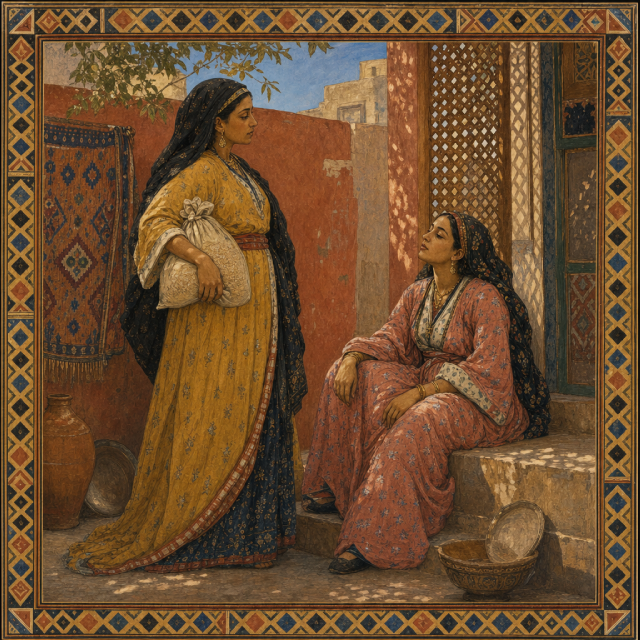
The Nile Delta, summer of 1898.
There was, in the village of Kafr el-Dawar, a woman who sang.
This seemed unremarkable. Women sang everywhere — grinding grain, rocking children, walking to the river with jars balanced on their heads. Song was as common as dust, as natural as the flood. No one paid it any particular mind.
But Nadia Khalil sang differently.
She sang as though singing were a thing in itself, an end rather than an accompaniment. She would stop in the middle of a task to listen to something no one else could hear, then sing — a line, a phrase, a melody that had not yet existed — and return to her work as if nothing had happened, slightly distracted, slightly elsewhere. Her husband had long since stopped worrying about it. Her children had grown up with this music the way they had grown up with the sound of wind in the reeds.
What was less unremarkable was that men stopped to listen.
Not the men of the village — those had known her since childhood and heard her without listening, the way one stops hearing the muezzin when one has always known it. No, the men who passed through. Merchants. The foremen from the English cotton fields along the canal. An Egyptian officer, once, who had dismounted for no apparent reason and stood in the dust for the length of one song before remounting without a word.
Fatima Khalil, Nadia's elder sister, did not sing.
Fatima worked.
It was the hottest summer in twenty years, the elders said, though the elders said this every summer. The cotton stood high, the flood was expected, and the men of the village spent their days digging, repairing, watching — irrigation did not forgive inattention. The women did the rest, which was to say nearly everything that remained to be done.
Fatima was awake before dawn. She kneaded the bread, lit the fire, organized the day with the precision of someone who had understood very early that the world did not organize itself. She had three children, a conscientious but slow husband, a mother-in-law who observed everything and approved of little. She also had stores: wheat in wax-sealed jars, lentils, oil. She had saved on cloth at the market, repaired what could be repaired, refused the expenditures that served no purpose.
Nadia had a dress she loved, two children she adored, and no savings to speak of.
The difference between the two sisters was visible, measurable, and entirely logical by the standards that governed life in the delta. Fatima was a serious woman. Nadia was a pleasant woman. This was not a judgment — it was an observation, the kind of observation that determines what you are given and what you are denied.
In August, Nadia came to knock at her sister's door.
She wore the same expression she had worn at fifteen when she had broken their mother's jar — an embarrassed lightness, her gaze slightly elsewhere, as though the situation were unfortunate but not entirely serious.
She needed grain. The month had gone badly. Her husband had had a fever. The children had eaten. Nothing remained.
Fatima let her in. She put water on to heat. She said: wait.
She went to the back room, lifted the lid of a jar, measured. She brought back what she could give without drawing down what she needed to last through the autumn. Not everything Nadia had hoped for, perhaps. But something.
Nadia thanked her. Her eyes were bright — with gratitude or something else, it was difficult to say. She said: you shall sing at my wedding if I marry again. It was a joke. Fatima did not quite laugh.
— You should have set something aside, said Fatima. Not unkindly. As a simple truth.
Nadia said: yes. Then: you're right. Then, after a pause, with a gentleness that was almost imperceptible: but if I had spent the summer counting lentils, who would have sung?
Fatima had no answer for that. Or rather — she had the usual answer, the sensible answer, the answer that everyone in the village would have given: no one, and no one would have missed it.
But the officer had stopped in the dust.
And Fatima, who was not a cruel woman, who was on the contrary a just and careful and attentive woman — Fatima had never made anyone stop.
She gave the grain. She said nothing more.
Winter came the way it always did, without quite surprising anyone and without quite warning anyone either. Nadia sang at the evening gatherings. The children slept against her. The grain held.
In spring, a man from Tantah who had heard of her made a proposal: to sing at wedding feasts, the grand houses, the families who paid. It was not a thing that was done. It was not precisely a thing that was not done either — the rules were vague on this point, as they were vague on many things concerning women who had gifts that no one quite knew how to name.
Nadia spoke to her husband. Her husband shrugged with the philosophy of a man whose fever had lasted three weeks and who had quietly revised his certainties.
She accepted.
Fatima heard of it through her mother-in-law, who had heard it from someone at the market. She stood silent for a moment, her hand in the flour.
She said: good for her.
And it was true. It was sincere. And at the same time — at the same time, Fatima stood in her well-ordered kitchen, her jars full, her children clothed, her husband home on time, with something in her that had no name and that she would not have known how to sing even if she had been capable of it.



