The Court Musicians
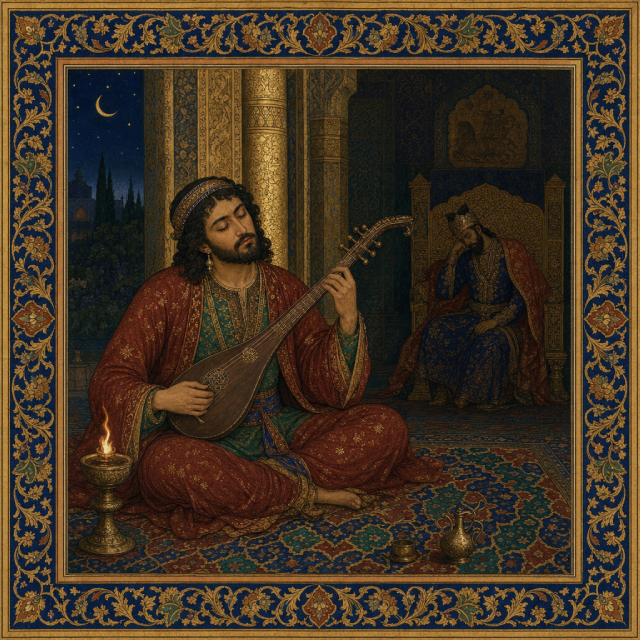
Barbad and the King's Secret.
Barbad never slept before dawn. Seated in the shadow of the columns at the palace of Dastagerd, he was tuning his barbat, that walnut-wood instrument whose body recalled a frozen teardrop. His fingers, calloused by years of practice, brushed the gut strings with a jeweller's delicacy.
That evening, King Khosrow the 2nd had summoned him. A new melody was expected, a mode never heard before that would celebrate the victory over the Byzantines. Barbad closed his eyes. He was not thinking of battles, nor of glory. He was thinking of the wind in the cypresses of his childhood, in Jahrom, and of a bird's song he had not heard for thirty years. That was where the music would come from.
When he played, what rose up was not a song of victory, but something deeper: the gentle melancholy of those who survive wars. The king wept. And Barbad knew he had found the seventh royal mode, the Khosravani, which would be forever lost to future generations.
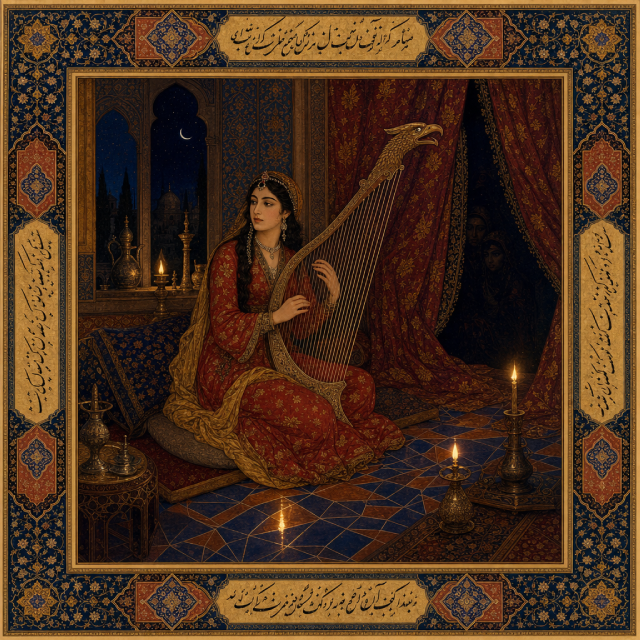
Nakisa and the Eagle Harp.
Nakisa held her chang against her like a child. The harp was carved from dark wood, and its crown was adorned with an eagle's head of ivory, beak open in a silent cry. Twenty-two strings stretched between sky and earth awaited her fingers.
She played alone, late at night, when the court had retired. Her music was not for the king, nor for the nobles competing in flattery. She played for the women of the private quarters, those who listened from behind the curtains, whose sighs she could sense in the darkness.
Each string had a name: Desire, Absence, Remembrance, Forgetting. Nakisa plucked them one by one, weaving a web of sound in which each listener could recognise herself. It was said she had composed thirty melodies, one for each day of the lunar month. But the most beautiful, the one she never played in public, spoke of a young girl who had had to choose between love and art. She had chosen art. And her harp wept for both.
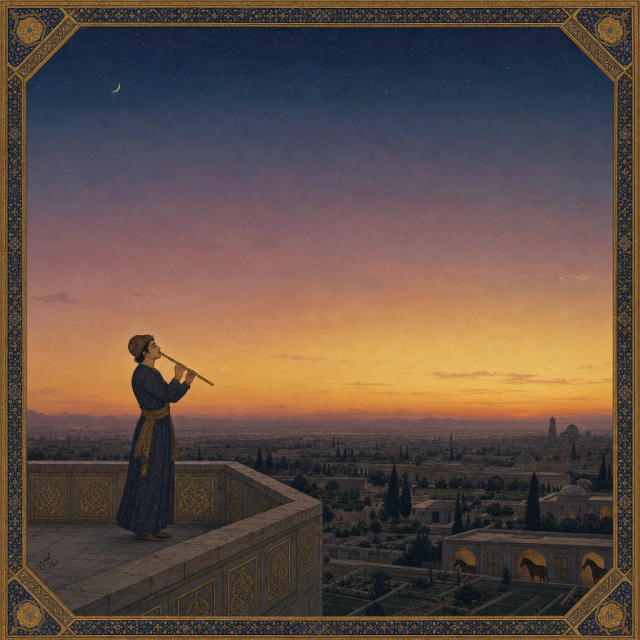
Bamshad, the Musician of Dawn.
Bamshad knew the sky before it grew light. Every morning, before even the roosters crowed, he climbed to the palace terrace, his reed ney in hand. The instrument was simple: seven holes pierced in a dried stalk, bound with worn cotton thread. But in Bamshad's breath, it became the voice of a world awakening.
He did not play the complex modes like Barbad. His music was made of long, suspended notes, which imitated the call to prayer before prayer existed. The first notes rose into the cold air, trembling like leaves. Little by little they grew fuller, coiling around the columns, sliding through the sleeping gardens.
In the stables, the horses pricked their ears. In the kitchens, the servants stopped their work. And up above, in the royal chamber, Khosrow the 2nd opened his eyes — not wrenched from sleep by a noise, but gently drawn back to consciousness by a music that reminded him another day had been given to him. Bamshad did not wake the king. He gave him the dawn.
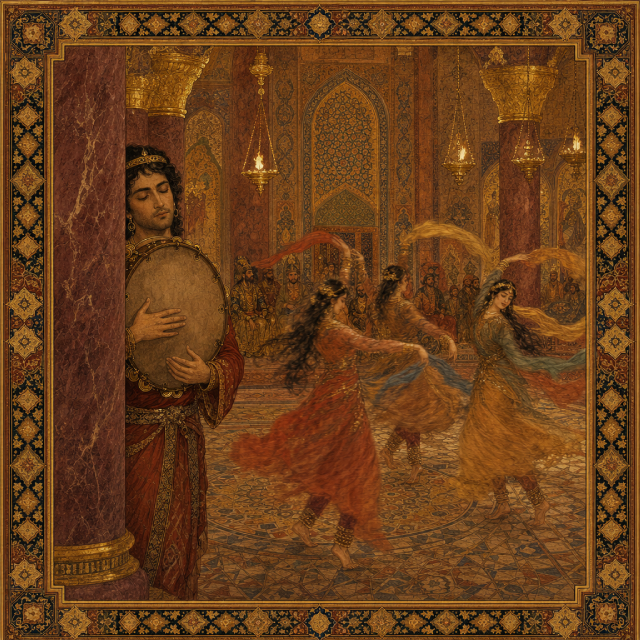
The Daf Player in the Throne Room.
No one ever noticed the daf player. He stood in shadow, behind the porphyry columns, his copper-rimmed frame drum held against his chest. The instrument was heavy, its goatskin head stretched taut and hung with metal rings that jingled at every movement.
While Barbad played and the poets recited their verses, he waited. His moment would come later, at the banquet, when wine had loosened tongues and relaxed limbs. Then he would begin, softly at first, a muffled rhythm that would follow the beating of hearts. Boom... boom-boom... boom...
Little by little the tempo quickened. The copper rings stirred, adding their bright jingle to the rumble of the struck skin. The dancers entered, bare feet on the mosaics, and their anklets answered the drum. The daf player saw nothing of the celebration. Eyes closed, he was the invisible pulse of the night, the one who set bodies dancing and made them forget, for the space of an hour, that tomorrow death might knock at the door.
The Breath of the Karna.
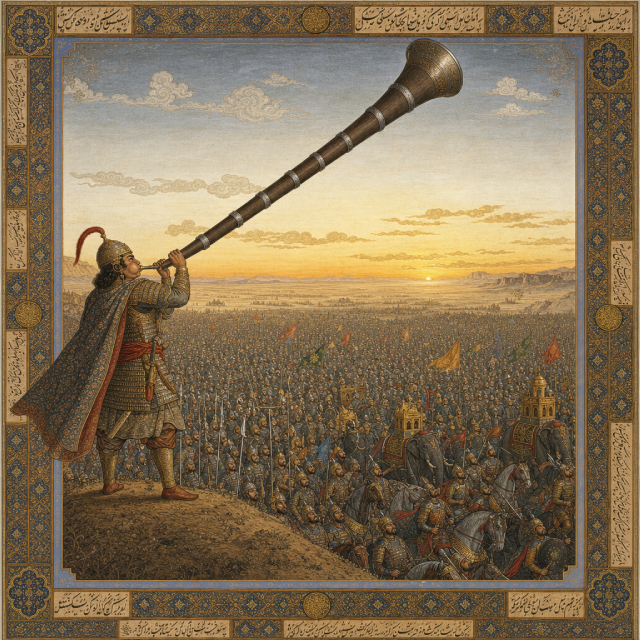
The karna was not an instrument for quiet palaces. It was a horn two metres long, in walnut wood ringed with silver-plated copper, its flared bell seemingly swallowing space. One did not hear it: it passed through you.
On the morning of great battles, when the Sasanian army drew up in order of combat, the karna player climbed a mound. He raised the instrument toward the sky, the mouthpiece to his lips, and blew. The sound that came out was nothing human. It was a deep, powerful roar that carried for leagues in all directions and silenced the birds.
That sound said: The King of Kings approaches. Tremble. Enemies heard it and knew death was coming for them. Persian soldiers heard it and straightened their backs, proud to be the instruments of a power greater than themselves.
The karna player knew nothing of subtlety. He played only three notes, always the same, repeated relentlessly. But within those three notes the entire empire was contained: its majesty, its strength, its terror. When he played, Khosrow II was no longer a man. He became the sonorous incarnation of absolute power.
The Silent Inheritance.
None of them knew they were playing for eternity. Barbad died in his bed, Nakisa vanished into the oblivion of the harems, Bamshad faded away on a winter morning. Their instruments rotted, their melodies fell silent when the Arabs conquered the empire.
But somewhere, in the dastgahs of modern Persian music, in the lute still called the barbat, in the sufi ney flute, in the drums of ceremonies, their breath survives. They did not die. They simply changed mode, passing from the royal Khosravani to popular melody, from court to people, from time to eternity.



