The Widow with No Name
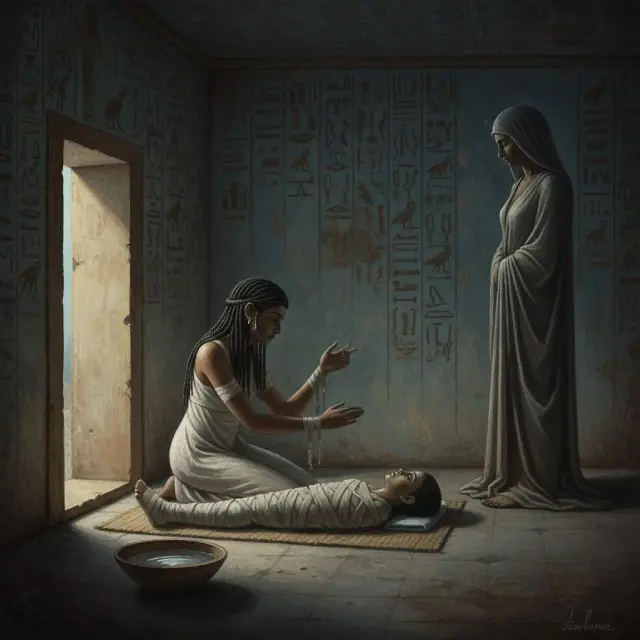
In Thebes, when the Nile recedes, the walls ooze dust; each stone seems to hold back a breath of escaping water, like a memory that refuses to die.
The streets, stripped of their boats, echo with the clatter of sandals on the compact sand, and the shadows lengthen until they merge with the silhouettes of the statues of Osiris, who stand impassively before the day's funerals.
The dead, more numerous than in the high season, await their shrouds as one awaits rain: patient, silent, they cling to the hope of a final veil that will free them from the tumult of the world of the living.
She had no name. Not really. She was called "she who hems the shrouds," or "the woman of the dark corner," or sometimes, when compassion sought to soften the harshness of daily life, simply "the widow." None of these titles touched her; Words, for her, were chains that the living wrap around their necks. The dead, she knew, no longer need these shackles: they already float in nothingness, free from all designation.
Every evening, after the priests had exhausted their formulas, the merchants had put away their oil flasks, and the children had disappeared into the alleyways, she slipped out of the darkness of her modest dwelling. It was neither duty nor faith, but a kind of visceral impulse: a naked body, exposed under the low moon, seemed to her an insult to the very silence of the night. She then felt the irrepressible need to cover this mute cry with a handwoven softness.
Her fingers, cold as the mist rising from the Nile at dusk, worked slowly, her back bent under the weight of years. She soaked the linen strips in a mixture of salt and myrrh, letting the sacred aromas penetrate the fibers. Each strip was wrapped around crossed arms, inert legs, and a face she never looked at. To see the features was to risk giving them a name; And to give him a name was to remain a prisoner of the pain that had once broken her heart.
The Night Everything Changed
That night, the wind carried an unusual coolness, as if the nearby desert had breathed a nocturnal breeze upon the city. The dead man was young, barely sixteen, the son of a potter whose hands had shaped clay for three generations. He had been swept away by the waters of a poorly maintained canal, his body found floating among the reeds.
His parents, poor but dignified, could only offer a simple shroud: no gold amphora, no amulet engraved with Isis. The widow stepped forward as always, but something held her back. The air around the young body was cooler than the oppressive heat of the workshop where he had spent his days. A subtle fragrance rose, unlike the usual cedar or myrrh resin: it was the scent of night at the edge of the desert, dry, strangely sweet, laden with a mystery that words struggle to capture.
She took a step back, her heart pounding like a sacred drum.
“Who are you?” she murmured, not to the young man who had died, but to the shadow that seemed to lurk behind him. Silence answered, but a light rustling sound, like a damp linen cloak sliding across the floor, could be heard. She looked up, and in the darkest corner of the small room, a figure stood upright, arms folded, head slightly bowed. It was neither a threat nor a sorrow; it was simply a presence, like a sister come to keep watch when no one else dared approach.
“You have no need of me,” the widow declared, her voice trembling but resolute. The shadow did not move, but the boy’s body, beneath the widow’s fingers, seemed to relax, as if the mere recognition of an unseen presence soothed its troubled soul.
Then she resumed her work. This time, her fingers no longer trembled. Each strip of linen slid with a new fluidity, as if the hand of fate were guiding her hand. When she wrapped the last strip around the boy's forehead, a fleeting sensation passed through her: light as a drop of dew on warm sand, a solitary tear slid down her cheek.
She didn't know if it was hers or the young deceased's, but the feeling was undeniable: a silent communion between two beings who, though separated by life and death, shared the same thread of existence.
The Dawn of the Miracle
In the morning, the priests discovered the body perfectly swaddled, the face serene, the eyes closed as if dreaming of a peaceful afterlife. They interpreted this as a miracle of Isis, the goddess who protects the dead, and their chants rose in the goddess's honor.
The widow, however, kept a deeper knowledge within her. She understood that the presence in the shadows was not a mere ghost, but Nephthys, the sister of Isis, guardian of forgotten souls, she who weeps unseen. In mythology, Nephthys watches over widows and orphans, offering quiet comfort to those left in darkness.
That evening, when she returned to her room, she left a small bowl of fresh water by the door, a symbol of purity and renewal, along with a lock of unwoven linen, an offering to the silent goddess. It was a humble, almost imperceptible gesture, yet laden with profound meaning: a tribute to the one who, in the darkest corners, gathers unshed tears and transforms them into eternal peace.
Poetic Epilogue
From that day on, each time the Nile recedes and dust seeps from the walls, the widow continues to adorn the bodies of the deceased, but now she does so with the certainty that a benevolent presence accompanies her. She no longer seeks to name the dead; she simply envelops them in silent love, knowing that, in the grand theater of the afterlife, each strip of linen is a note in a melody that only the gods can hear.
And in the darkest corner of each burial chamber, a figure always stands, arms folded, head bowed, ready to welcome the next soul to cross the threshold, offering the widow a silent companion, a shadow sister, a guardian who weeps unseen.



