Saint-Cyprien
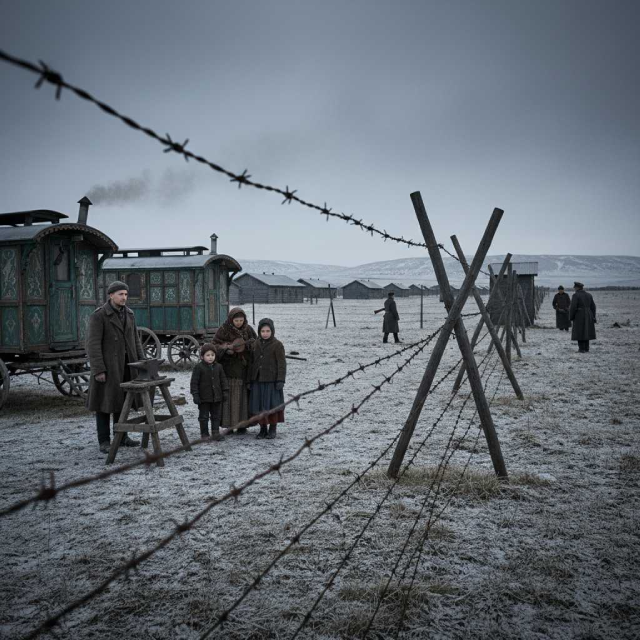
After the defeat, the Vichy authorities implemented repressive measures (census, internment, deportation, forced labor) against these populations. One of these concentration camps was in Saint-Cyprien.
In memory of my grandmother,
whose suffering went unrecognized during her lifetime,
and who bore a shame that was not hers.
When winter of 1941 settled over the plain, the barbed wire wasn't quite straight yet. It had been hastily strung between flimsy posts, and the wind made it vibrate like out-of-tune strings. For the gendarmes, it was a minor detail. For those who lived on the other side, it was a false promise: they could see the landscape, but they could no longer go there.
The Reinhardt family had arrived there in October, with two caravans, a violin, a portable anvil, and children too quiet for their age. They didn't know the name of the place; they had been told "the camp," as if that were enough. Before, they had said "the road." Afterward, they learned to say "the waiting."
Mathias Reinhardt was forty, maybe forty-five: he wasn't exactly sure. He repaired pots and locks, straightened worn-out tools. He had learned to work quickly, to speak little, to keep his papers in an oilcloth. He had shown these papers so many times that he knew every fold. They had been taken from him at the entrance, with an almost polite gesture. “We’ll give them back to you,” a man in uniform had said. Mathias hadn’t asked when.
His wife, Katarina, counted the days from the laundry days. She knew how many shirts lasted before the water ran out, how many times a garment could be mended before the thread broke. She observed the guards without staring, with that discreet attentiveness one develops when living for a long time under regulations that change without warning. She didn’t expect kindness; she hoped for regularity.
There was also Anna, twelve years old, and Jakob, nine. Anna had kept a school notebook, salvaged in the confusion of their arrival. She wrote in it at night, by the harsh white light of a bulb protected by a cage. She jotted down seemingly insignificant things: the color of the sky, the way the soup steamed, the sound of footsteps at night. She didn't write about fear. She wrote about noise.
The camp wasn't meant to last, some said. Yet it had its routines. In the morning, roll call. The children lined up, the adults counted. Mispronounced names, scribbled numbers. Mathias had been assigned a task: repairing the locks in the depot. He worked under the watchful eye of a sergeant who enjoyed watching him, like one watches a well-oiled machine. Sometimes, they asked him if he knew how to play. Mathias answered yes, a little. He no longer played. The violin had lost its voice.
There were other families, other first names. Elders who spoke little, women who sang softly to soothe the younger ones. News circulated but never settled. There was talk of camps elsewhere, of transfers, of promised releases. It was also said that some had been arrested before the war, for the same reasons, under different laws. This gave the confinement a strange weight: it wasn't an exception, but a continuation.
One day in December, a schoolteacher from the neighboring village entered the camp, accompanied by a gendarme. He looked at the children as one might look at a class one hadn't chosen. He asked if they could read. Anna raised her hand. He gave her some loose sheets of paper, simple exercises. "You will help the others," he said. Anna took the papers seriously. She didn't say thank you; she set to work. Katarina observed the scene without seeing any sign in it. She had learned that acts of kindness could coexist with injustice without correcting it. She put the sheets of paper in a tin box. That evening, Anna wrote: We got paper.
Winter passed. Spring brought mud and rumors. There was talk of departures to the east, then nothing at all. Families were separated. It was explained that it was administrative. Mathias looked for familiar faces, then stopped looking. He focused on what he could still do: adjust, repair, maintain. Repairing became a form of quiet resistance: as long as something worked, the world wasn't completely broken.
One morning, Jakob fell ill. Nothing dramatic: a fever, a persistent cough. The doctor came by, in a hurry. He noted something. Katarina asked if Jakob could stay indoors. The answer was yes, for today. The next day, the fever had subsided. The routine resumed. Jakob recovered slowly, with the stubbornness of children who refuse to become a problem.
The following year, the war seemed to recede without truly receding. Uniforms sometimes changed color, but not function. Papers returned, or not. Mathias retrieved some of his. Some were missing. He didn't ask which ones. He learned that the road might be open again. Perhaps had become a dangerous word: too fragile to rely on.
When liberation arrived—for it did—it didn't take the form Anna had imagined. There was no music, no speeches for them. The gates were opened. They were told they could leave. They were reminded that there were rules, always. The Reinhardt family left with what they had: less than when they arrived, but not nothing. The road was there, the same and yet foreign. They looked for a place to stop. They were asked to move forward. They were reminded of decrees that had not been repealed. Mathias showed his papers. They were examined at length. He was told to come back. Katarina understood that the war was over, but not over for them.
Years later, Anna, now a woman, would recount this period without calling it a camp. She would say the time of barbed wire. She wouldn't raise her voice. She would describe the details: the sound of the wind, the exercise sheets, the lock repaired too often. She would say that forgetting is not an accident, but a habit.
In a village, an old man remembered one day that there had been a camp there. He told his grandson as they passed a vacant lot. There were families there, he said. He couldn't remember the names. The grandson asked: And then? The old man shrugged. Then they left.
The barbed wire had long since disappeared. The stakes too. The wind still blew. Those who had lived there knew that the absence of traces did not mean the absence of history. They knew that some destinies leave no monuments, only worn notebooks, passed-down gestures, and a quiet distrust of promises that are too clear.
Anna kept her notebook. The pages were yellowed. At the end, a simple sentence, written much later: We were there.



