Derya's Defter
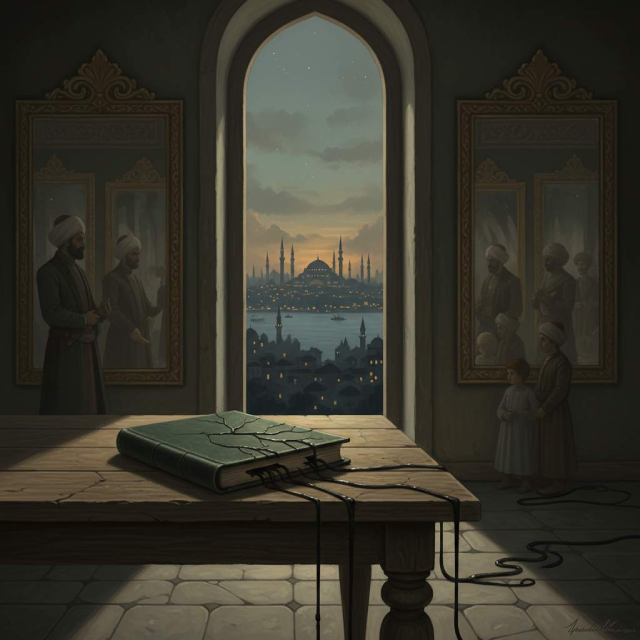
1895. Summer pavilion at Büyükada, Princes' Islands.
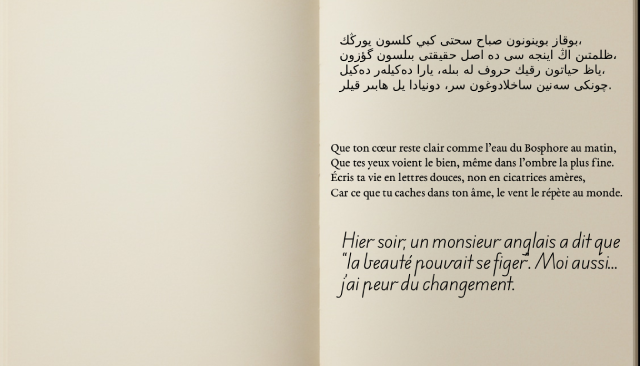
Derya, a nine-year-old boy, the son of a poet of Circassian origin and a high-ranking Ottoman official, sits at his rahle. The open windows let in the scent of jasmine and the sound of waves. With a silver pen in his hand, he admires the light dancing on the green leather cover of the defter his mother has just given him. The notebook is new. Nothing is hidden. He opens it to the first page, blank. He copies his mother's quatrain:
“May your heart remain clear as the waters of the Bosphorus at dawn,
May your eyes see goodness, even in the faintest shadow.
Write your life in gentle letters, not in bitter scars,
For what you hide in your soul, the wind repeats to the world.” He writes diligently, his tongue between his teeth, his heart light.
The Temptation.
In a high-ceilinged drawing room, adorned with Venetian mirrors and Hereke carpets, a man and a young boy are drinking tea. The windows overlook the Golden Horn, where the lanterns of the caiques shimmer on the dark water. Velvet curtains trap dust and whispers. The air smells of Smyrna tobacco, beeswax, and a hint of faded jasmine.
Derya is twelve years old. He is dressed in a plum-colored silk waistcoat and a white şalvar. His dark hair is still a little long, the kind children leave long.
Lord E., a British dandy with a honeyed smile, keeps him company. He speaks Turkish with an accent that tickles the ear like a false note on a ney.
A servant discreetly brings rose tea.
The other guests have left.
The fire in the fireplace crackles, casting shadows that dance on the walls like curious djinns. Lord E. gazes at Derya. Not as a man looks at a child, but as a collector admires a porcelain cup: with longing, and the tempting thought that it might shatter.
“You are like a cloudless morning on the Bosphorus,” he says, his voice low. “But mornings pass. Faces wrinkle. Eyes lose their sparkle.” He extends a gloved hand, not touching, but suggesting.
“And if you could keep this light… forever?” Derya doesn’t answer. He stares at the candlelight. He doesn’t understand everything—but he feels, in his chest, a small door opening. A door he didn’t know was closed.
The silence continues. The servant carries away the empty cups. The night deepens.
Later, in his room, Derya sits at his small rahle, the defter open before him. He dips his quill in India ink. He wants to write down what he felt. Not the compliment, no—but the thought that came to him afterward: What if I never changed?
He writes, slowly: “Tonight, an English gentleman said that ‘beauty can freeze.’ Me too… I’m afraid of change.” But no sooner has he traced the words “I’m afraid” than the ink runs. Not a drop—no. The word stretches out as if it were melting. A thin black trail slides down to the maternal quatrain.
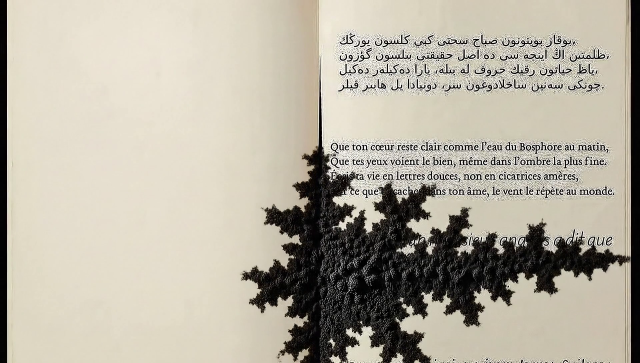
Derya holds his breath. He looks at the quatrain—the one he copied so carefully when he was nine.
But tonight, beneath the last line, a black stain grows, slow and silent. It doesn't tear the paper—it fills it from within, like mold.
Derya brushes the page. The ink is dry. Yet he feels the cold beneath his fingers.
He closes the notebook. The green leather, soft as the skin of a fruit, betrays nothing.
But Derya knows—without knowing how—that he mustn't leave it open again.
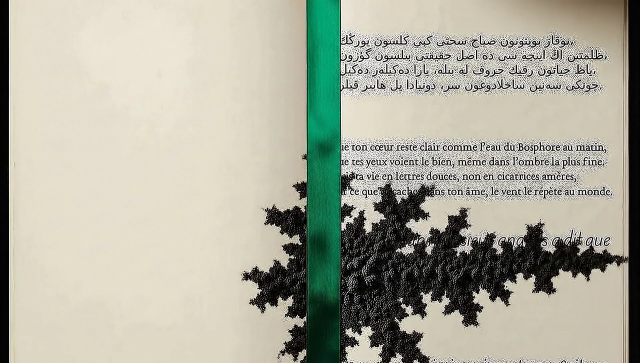
He slips a green silk ribbon between the pages, like a blindfold over the eyes of a dead man.
The First Lie.
There is a small walled garden behind the mosque, shaded by a centuries-old mulberry tree. The walls are covered in flowering wisteria, whose fragrance is so strong it's intoxicating. A marble basin, almost dry, occupies the center. It is there, away from prying eyes, that young people from good families gather.
Derya meets Yusuf, her childhood friend, the son of a carpet merchant from Balat. They are both 14 years old. Yusuf is holding a letter, an anonymous denunciation of his father, accusing him of fraud.
Prince C., the deposed heir of a junior branch, who runs the same business as Yusuf's father, is half-hidden in the garden.
Yusuf, his face pale, hands the letter to Derya.
"You are close to the prince," he says, his voice trembling. "If you say my father is innocent... he will believe you." Derya hesitates. He knows Yusuf's father is innocent. But he also knows the prince demands a favor: to bring down a rival.
And Derya, for the first time, makes a choice.
He takes the letter. Crumples it. Throws it into the nearly empty basin.
"I will speak," he says.
He won't.
That same evening, Yusuf's father was arrested. He hanged himself in his cell.
In his room that night, Derya retrieved the defter from its hiding place under the floorboards. The green ribbon was still in place. He carefully removed it—as if the page were about to scream.
He wanted to write an apology. Not for others. For himself.
He dipped the pen. He wrote:
“Yusuf’s father was innocent. I lied.”
But the ink didn’t dry. It shifted.
The letters twisted. The word *suçsuzdu* (“was innocent”) became *suçluydu* (“was guilty”).
The word *yalan* (“lie”) became *gerçek* (“truth”).
Derya frantically tried to erase—but the paper absorbed the gesture. In place of the scraped-off words, black veins appeared, as if the page were bleeding silently.
He turned the page. Look at the quatrain.
The word "ruh" ("soul") has disappeared. In its place: a small tear in the paper, shaped like a teardrop.
He closes the notebook.
He places the defter in a rosewood box, secured with a silver clasp.
Then he buries the box beneath the garden paving stones.
The Silence of Goodness.
Istanbul, winter 1902 — Galata district, Derya's apartment.
For two years, Derya hasn't opened the defter. The rosewood box lies beneath the flagstones of his childhood home in Büyükada. But the notebook breathes from a distance.
Each time an act of cruelty is committed in its name, the pages darken further—even without his touching them.
And around him, accomplices are born, without his wanting them… or even knowing it.
For example, Hikmet, a former tutor, now embittered and dismissed, spreads rumors about Derya in the cafés of Beyoğlu. He invents crimes that Derya didn't commit—but the notebook absorbs them as truths. Evil feeds on lies about evil.
Thus, a young palace official, flattered to be invited to Derya's home, begins to imitate her mannerisms, her silences, her cruel choices. He doesn't know that Derya is watching him—and lets him, as one might observe the growth of a poisonous plant.
A letter informs Derya that a former servant—the one who brought the rose tea he drank with Lord E.—has hanged himself in a stable after being ruined by debts Derya incurred in his name.
He feels nothing. No anger. No sadness. Only emptiness.
He walks to the window. Snow is falling on Galata. The bells of an Armenian church are ringing too slowly.
He knows he should feel something.
So, driven by a childlike instinct, he decides to write.
Not to justify himself.
But to see if he is still capable of it.
He goes down to Büyükada. Digs under the slab. Opens the box.
The defter is heavier than before. The leather is still green—but cold to the touch, like marble.
He sits down by the unlit stove. Opens the notebook to a blank page; there are a few left.
He dips the pen. Wants to write: “Affet…” (“Forgive me…”)
But the pen leaves no trace.
He presses harder. The paper tears—but the ink doesn’t appear.
He turns the pages frantically.
His mother’s quatrain is almost entirely erased.
Except for the last line: “…the wind repeats it to the world.” He understands that the notebook no longer accepts his words but continues to act.
He closes it. He no longer hides it. He leaves it on the table, next to a cup of cold tea.
He knows, without saying it, that it has become useless.
Evil thrives on its own.
Leyla, a young, distant cousin, an orphan who came to live under her protection, admires Derya like a god. She cleans her room, tidies her things. She finds the notebook, flips through it—understands neither the words nor the black marks, but feels their coldness. She puts it back. And in her pocket, there is now a small mirror she stole.
Evil doesn't need Derya to grow.
It finds new ground.



