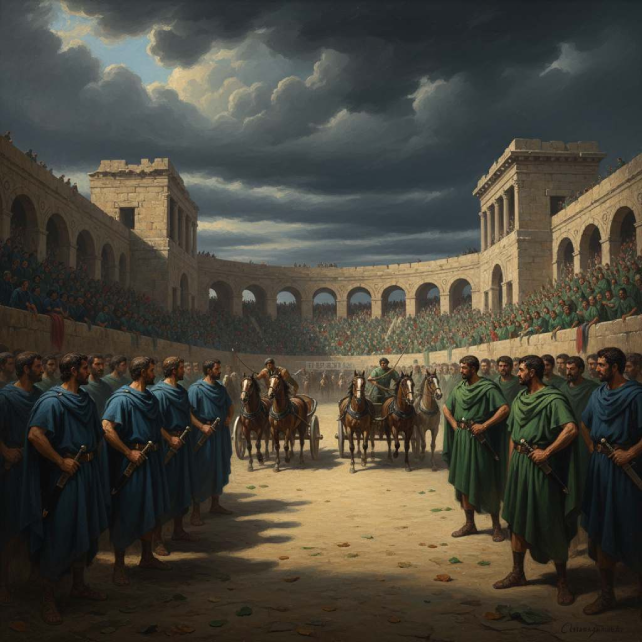
The Colors of Fury
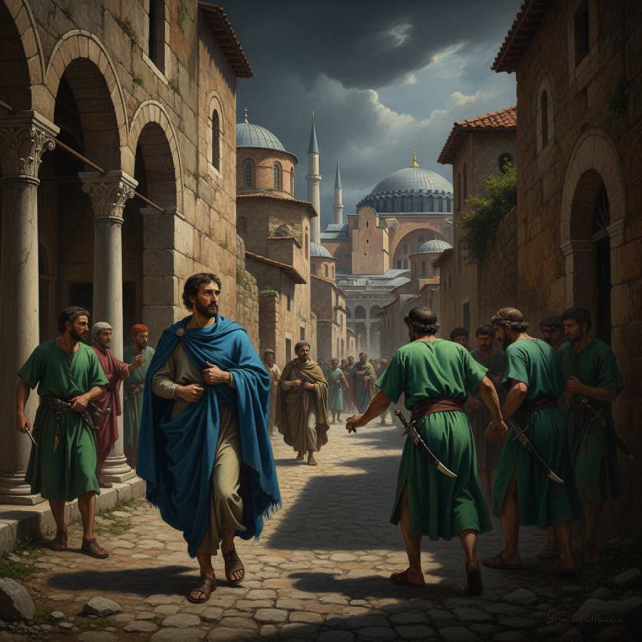
Constantinople, January 532 AD.
Theophilus clutched the edge of his blue cloak tighter to his chest. In the narrow streets leading to the Hippodrome, every color was a war flag. He carefully avoided the gaze of a group of men in green tunics who were marching along the opposite wall, their hands never far from their belts where knives hung.
Three months earlier, his brother Demetrius had come home with a bloody face. Not because of a robbery, not because of a personal quarrel. Simply because he was wearing the blue of the Democrats, the imperial team, the one supported by Emperor Justinian himself. The Greens—the Prasinoi—had caught him near the Forum of Constantine.
“They called me an imperial dog,” Demetrius had spat through his broken teeth. “As if the colors of a stable determined a man’s worth.” “But that was exactly what they were doing now.” Théophile remembered a time, not so long ago, when horse racing was simply a form of entertainment. People chose their team based on family tradition, neighborhood, or simple aesthetic preference. The Blues against the Greens, the Reds against the Whites—four factions that filled the Hippodrome with a clatter of hooves and joyful shouts.
Then the colors became laden with meaning. The Greens became the refuge of those who challenged the religious orthodoxy imposed by the emperor, Monophysites who saw Justinian as a tyrant. The Blues embodied imperial power, the established order, the official doctrine. The divide between the two camps continued to widen.
In the taverns, people no longer mingled. The churches themselves were no longer sanctuaries: the previous week, Blues had chased a Green into Saint Sophia, stabbing him at the foot of the altar. The blood on the white marble had taken hours to clean.
“They’re going to massacre us one day,” murmured a voice near Theophilus.
It was Irene, his neighbor, who was discreetly wearing a green scarf under her veil—her husband’s, imprisoned the previous week for shouting insults at Empress Theodora during a race.
“Or we’ll massacre them,” replied Theophilus without conviction. That January morning, no one yet knew that the death sentence pronounced against seven rioters—four Greens and three Blues—would ignite everything. No one knew that the people, for once united in their rage against injustice, would shout “Nika!”—Victory!—and transform Constantinople into hell. What Theophilus knew, however, was that the colors people wore were no longer mere fabrics. They had become skins that could no longer be removed, banners under which they lived and under which, perhaps, they would soon die.
In three days, the Hippodrome would be ablaze. In five days, the entire city would burn. And in six days, thirty thousand bodies would lie in the smoldering ruins of what had once been the greatest city in the world.
But for now, Theophilus was simply walking toward the marketplace, his blue cloak clutched tightly to his chest, praying to return home alive.
For in Constantinople, the color of a garment was now worth more than the blood that flowed in one's veins.