(1)The Harem Calligrapher
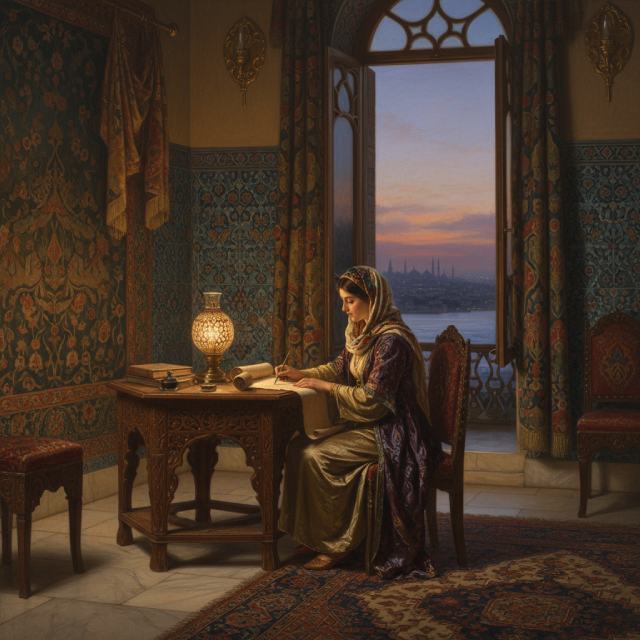
The reed pen traced without trembling, but within her, everything wavered. As she copied, the letters took on a life of their own, no longer like lines of ink, but like veins swollen beneath the paper's surface. Each loop opened with a sigh, each arabesque breathed a stolen memory. The young calligrapher told herself that words, when locked away for too long, always find a way to escape. Beneath the mother-of-pearl-inlaid flagstones, in the heart of walls polished like the mirrors of the favorites, a thousand similar secrets undoubtedly lay dormant—heartbreaks, oaths, betrayals. Dolmabahçe purred in silence, but its broad, heady belly rustled with unintelligible whispers.
Her name was Zehra, but her name meant nothing within the palace. They called her "the steady hand" because her calligraphy, fluid and delicate, seemed devoid of all emotion. Yet, this absence was her only way of existing: she was chosen precisely because they believed she wouldn't read. She belonged to that invisible race whose eyes are made to decipher without understanding. But the letters had pierced her like a thread of gold through silk.
In the evening, the rooms were fragrant with wax and amber. The lamps dimmed with a bluish sigh, and the flickering light glided across the shimmering surface of the Bosphorus. The palace then floated between two waters, like a dream one hesitates to leave. It was at this hour that she discovered the crack, a split joint between two Iznik tiles. Running her fingernail along it, she felt the trembling of the hidden paper, the soft dampness of forgotten things.
She could have summoned the harem guards, warned the duenna. But curiosity is a thirst that no prudence can quench. She lifted the pane of glass; an ancient scent, made of salt and ash, escaped. Three sheets of paper stared at her, tightly folded, bound with a silken thread. The handwriting was of an almost indecent beauty, even more assured than her own, with that vibrant tremor that no copy can imitate.
The letters were addressed to a crossed-out first name, replaced by a strange symbol: a broken star, as if the name had burned away. In the first, the woman wrote of her fear of the day "they" would come, and her certainty that the man would not survive it. In the second, she implored him to keep "the scarlet flower hidden behind the archives"—a symbol or code she did not understand. In the last, the briefest, the woman swore that she would return, even in a different guise.
The young calligrapher felt her heart pounding in her chest. These letters weren't mere expressions of love; they spoke a language of secrecy. There was something of a pact or a conspiracy in the way the name was concealed. Perhaps a love between two irreconcilable worlds: that of the Sultan, heavy with gold and perfumes, and that of the revolutionaries being hanged on the docks at daybreak.
In the days that followed, Zehra continued working as before, copying the frivolous poems of her favorites—those verses where love never lasts longer than a glance. But every evening, a tension vibrated beneath her neck. She thought of the letters hidden in her pen case, of that vanished hand that had loved someone beyond walls and laws, and of her own, which betrayed them by awakening them.
She set about copying them exactly, with almost religious meticulousness. Not to betray them further, but to save them from oblivion. The new paper absorbed their wounds. Then she placed the original sheets together, searching in the erasures for a sign, an initial, a flaw. In places, the ink had thickened like dried blood, and the imprint of a browned petal remained—rose or carnation? One could sense a hand that had wept over its work.
In the glow of the Bosphorus lanterns, she thought she glimpsed a figure in the reflections: the face of a woman she didn't know, but whose sorrow already felt like her own. Rumors swirled around the palace. Arrests had been made in Üsküdar; there was talk of a network of secret printers, a seized manifesto, and a name whispered: that of a woman of letters, missing for two years. It was whispered that she was still alive, hidden among the servants of a grand house. Zehra felt the cold edge of chance settle upon her: what if this handwriting belonged to the one everyone was searching for?
One night, as the watch boats glided beneath the mulberry trees on the shore, she rose, seized the copies, and went out into the servants' courtyard. Dew clung to her ankles. She walked to the mosaic pavilion, where the peacocks sleep against the railings. Beneath a cracked stone, she placed the copied pages, wrapping them in embroidered fabric—her only adornment. An offering, or perhaps a testament for a future generation who would learn to read.
Then she returned home, leaving the originals in their hiding place. But the very next day, the stone had moved. Someone had lifted it, then replaced it. No trace, no word. Just the impression of a breath that, from then on, knew her secret.
In the following days, the palace seemed to respond to her with ambiguous signs: a lingering glance from a eunuch, an order delivered with feigned absentmindedness. In the seraglio, one of the favorites summoned her to decorate a new tapestry; Zehra sensed in the request a cloying curiosity, a scruple disguised as a whim. They wanted to see her hands up close. They trembled slightly, despite herself.
That very evening, she found a very pale red petal in her inkwell—identical to the one affixed to the letters. Chance, in Dolmabahçe, no longer existed.
From then on, she wrote differently: less to reproduce than to erase. Her letters became darker, almost illegible, as if the ink itself knew it was being spied upon. She invented poems that seemed ancient; between two lines of submissive love, she slipped in words that belonged to no one: sanctuary, ash, shore, fire. These words were not for favorites. They were signals, tiny and persistent, like invisible lanterns on the banks of the Bosphorus.
One morning, the old housekeeper summoned her: someone had sent a sealed scroll bearing her name, something unthinkable according to harem etiquette. The seal depicted, very finely engraved, a broken star. Inside, there was only a short message, written with a sure hand:
“Keep what you have copied. The eyes that look at you cannot read.”
She burned the paper without thinking, but the act bound her more than the text. From that moment, she knew she had entered a larger game, woven between love and rebellion.
The days grew heavier, the light yellower, as if the palace were visibly crumbling. It was said that the Sultan himself no longer slept soundly, haunted by the absent. The favorites prayed longer in their niches, and the air smelled of fear mingled with jasmine. One evening, as she was putting away her inks, a sharp noise—a pane of glass struck by the wind—caused a tile to fall, exactly like the one in her hiding place. Behind it, she saw, for a moment, the tip of a gaze glint. Too short to know if it was real.
Since then, Zehra has worked with a funereal slowness. Every evening, she carefully cleans her pens in lavender-scented water, as if to ward off a stain that only she can still perceive. Yet, sometimes, a reflection appears in the ink: the glimmer of a shattered star, the memory of a face that never existed.
Dolmabahçe slumbers, a vast beast of stone and silk. But beneath its galleries, something watches.
And, in a calligrapher's secret drawer, now rest two bundles of letters: the originals, which speak of love, and the copies, which will one day speak of revolution.



