Freyja's Necklace
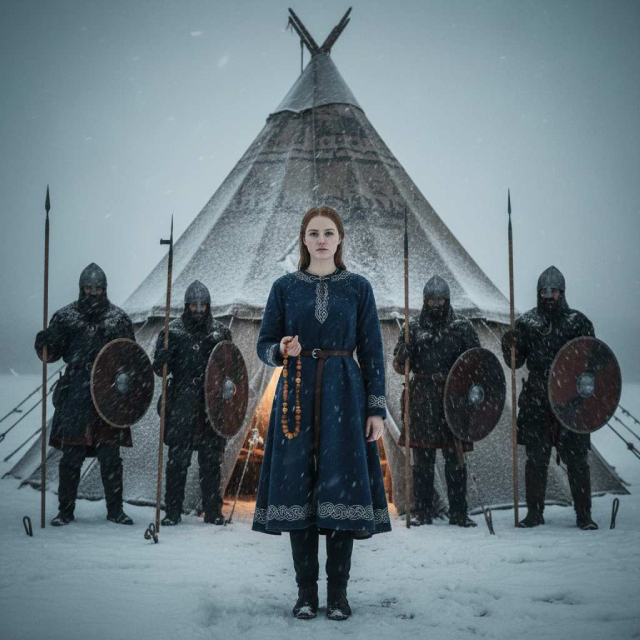
Winter had come early that year. Not the soft white blanket of fairy tales, but a hungry beast with fangs of frost, prowling around the longhouses and biting the fingers of unwary children. In the Skjaldbreiðr valley, where the mountains lean over their secrets like old men, Hildr no longer wept. She had wept all autumn—until her tears froze on her cheeks, they say in the hamlet.
Her brother, Einar Bright-Eyed, had not died a hero. He hadn't even brandished his axe. He had gone to trade salt for leather with the people of the East Fjord, carrying only his belt knife and a smile too genuine for such a harsh world. He had been found near a split rock, his skull opened, his wares stolen, his body half-eaten by crows. The trail led to the clan of Thorgrim the One-Eyed—a warrior whose reputation reeked of rancid blood and sour beer.
The law demanded vengeance. Hildr’s father, weakened by fever for weeks, could neither raise his voice nor his sword. The cousins whispered, “Let a man go. Let blood flow.” But there were no able-bodied men left—only widows, boys too young, and Hildr, who was neither.
She took neither weapons nor an escort. One morning, when the sun was but a pale promise behind the clouds, she donned her finest tunic—midnight blue, edged with silver thread—and placed her mother’s necklace around her neck.
It was an ancient jewel, made of amber beads, tiny hand-hammered gold discs, and a teardrop-shaped pendant: an amulet dedicated to Freyja, goddess of lost loves and impossible choices. It was said that whoever received this necklace as a gift had to offer, in return, a part of their soul—or bear the weight of an unspoken oath.
Hildr walked for three days. The wind whipped her face, the snow swallowed her steps. When she arrived at Thorgrim's camp, the dogs barked, the warriors laughed. "A girl alone? Have you come for your brother... or your death?" a man shouted, raising his spear.
But Hildr didn't answer. She walked through the circle of fires, straight as a yew tree, and stopped before the chieftain's tent. Thorgrim emerged, massive, his beard braided with copper, a scar dividing his eyebrow in two. He recognized her at once.
“You’ve come for the blood,” he said, his hand on the handle of his knife.
“No,” she replied. “I’ve come for the gift.”
And without trembling, she unfastened the necklace from her neck. The amber clinked softly, like a distant bell.
“This belonged to my mother. Before her, to her grandmother. It was blessed in the temple of Uppsala, steeped in the sacred waters of Lake Mälaren, and worn at three weddings and two funerals. If you accept it, Thorgrim son of Ormr, you must mourn your own son for a full year. Not a victory song, not a sip of beer in his honor, not even a glance at his shield hanging on the wall. For this necklace does not bind hands—it binds shadows.”
A thick silence fell over the camp. Even the wind seemed to hold its breath.
To refuse a gift, especially a ritual one, was to brand oneself with the mark of cowardice—worse than defeat. But to accept it was to acknowledge that Einar’s death was unjust, that it deserved redress… and that the price would be paid in pain, not gold.
Thorgrim stared at the necklace. Then he looked up at Hildr. In his eyes, she saw neither anger nor defiance—only an ancient weariness, the weariness of men who have killed and lost too much.
He held out his hand. Cautiously, as one touches a flame.
“I accept it,” he said.
And that evening, in the enemy camp, Hildr drank the ale of peace. She didn’t smile. But she knew: vengeance didn’t need an axe to be complete.
For sometimes, the heaviest burden isn’t death—it’s the memory one is forced to carry.



