The Mirror Shop of Istanbul
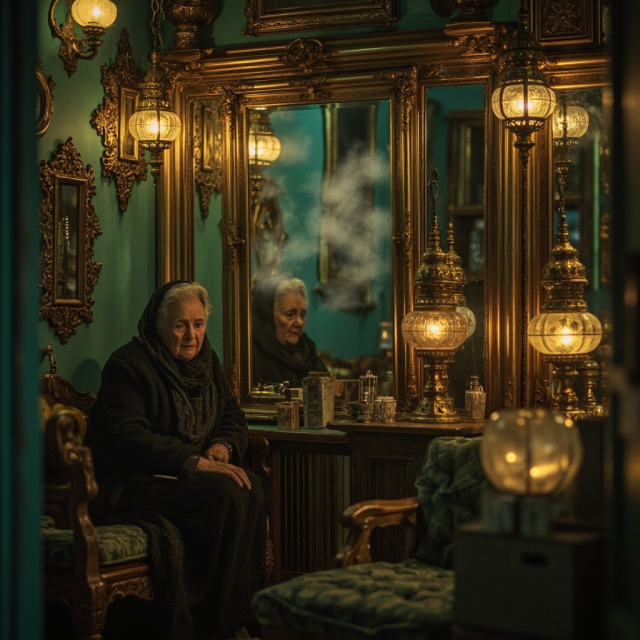
In the heart of the Balat district, in an alley where pale facades leaned towards one another as if to share a secret, lived Zeynep, a seller of antique mirrors. Her shop, narrow and warm, overflowed with gilded frames, speckled glass, and reflections that brushed against each other like silent spirits. Few knew that Zeynep had once been a servant in the imperial harem, responsible for maintaining the mirrors where the sultan's favorites gazed at themselves.
One winter evening, as a salty wind rose from the Golden Horn, a stranger handed her a mirror wrapped in faded silk. On its delicate frame, an inscription in unknown script wound its way between two engraved roses: symbols she recognized but couldn't decipher—the secret handwriting of her former lover, Safiye Hanım, who had vanished twenty years earlier after a night of fire and stifled whispers.
That night, Zeynep hung the mirror in her shop to clean it. But when she leaned her face into it, a mist formed behind her reflection. In the glass, she thought she glimpsed a room in the palace—the one where Safiye Hanım would run perfumed combs through her hair. Then a voice, faint as a memory, whispered:
“Don’t believe what they said. Seek the truth in the symbols.”
In the days that followed, each reflection changed with the time of day—in the morning, the silhouette of a black bird appeared; at dusk, a hand carving letters on a stone. With the help of a young calligrapher from the neighborhood, Zeynep discovered that the encrypted symbols formed a coded poem—a farewell message transformed into an enigma, linking Safiye's disappearance to a state conspiracy and the jealousy of a vizier.
But the more she deciphered, the darker the city seemed to grow around her: men prowled near her shop, a muezzin suddenly changed his call to prayer, and even the sea appeared to reflect something other than the sky.
At the last fragment, the entire sentence appeared, etched in the glass by a trembling hand:
"If you erase your past, it will condemn you."
At that moment, the mirror cracked with a thin line—not shattered, but set free. Zeynep understood then that it wasn't her mistress's secret she had uncovered, but her own: the secret of a memory she had never dared to confront.
She had never truly been able to leave behind the rustling of silk and the muffled laughter of the harem, echoes that still resonated in the corridors of her memory every time she closed her eyes. The scent of incense, the nighttime songs of the servants who sang to appease the sultan's whims—all of this was part of a life in which she was both invisible and indispensable: invisible to the outside world, indispensable to preserving the palace's secrets.
By selling mirrors, she sought to reflect only the faces of her clients, but each polished surface involuntarily brought back the reflection of a stolen youth, an identity crushed by power beneath the weight of velvet sheets. What haunted her most was the loss of her own voice; once, she had murmured prayers for the ladies of the harem, now she could utter nothing, her voice sounding like the clinking of broken glass, as if every word had been swallowed by the silence imposed by the years.
The secret Safiye Hanım had confided in her was, in reality, the last thread connecting Zeynep to this forgotten existence. By deciphering the coded poem, she realized that the true enigma was not the vizier's conspiracy, but the unspoken pact she had made with her own oblivion: "Never look back, or the past will consume you."
Each shard of the mirror she shattered was a desperate attempt to rid herself of the guilt of having survived while so many other women perished in the palace flames. She had learned to bury those memories beneath piles of gilded frames, to mask them behind the shimmering reflections, hoping that time would dissolve them like dew in the sun. But the glass, faithful guardian of truth, could not be ignored indefinitely; it forced her to confront the pain of a stolen childhood, broken promises, and shattered dreams, reminding her that the only way to truly forget was to accept them and let them vanish into the waters of the Bosphorus.
She left the shop, walked to the Bosphorus, and threw the shards of the mirror into the water. In the water, a thousand reflections danced, like so many truths freed from the palace walls.
Since that day, every mirror sold by Zeynep is said to show a slightly off-center reflection — the echo of a story that no one can completely erase.



