The Gods' Smoke
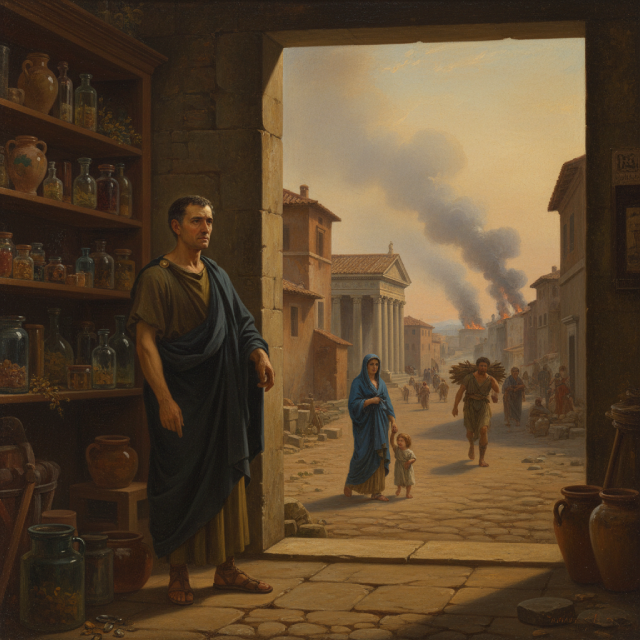
Rome, 166 AD
Marcus Aemilius Rufus had been an apothecary for thirty years. He knew the smells of death — that of cedar wood in burial shrouds, that of nard on the corpses of the wealthy, and the more honest smell of putrefaction in the poor quarters of the Subura. Those smells he had learned to keep in their place.
What he had been smelling for two days, ever since the soldiers from the Parthian front had begun to return, was different.
A sharp, almost sweet odor that resembled nothing he kept in his jars. It came from the mouths, people said. It came before the pustules.
He closed his shop earlier than usual that evening.
The news had taken weeks to cross the Mediterranean from Seleucia. People said the soldiers had opened the tomb of a god — some said Apollo, others a eastern god whose very name was a curse — and that black smoke had escaped from it, blowing first toward the East, then toward the West, and now entering Rome through the same gates the victorious legions of Lucius Verus were marching through.
Marcus was not a man who believed in smoke from tombs. He believed in Galen, the Greek physician who treated gladiators and who was said to write down everything, absolutely everything, with the cold precision of a land surveyor.
He also believed in what he saw.
And what he saw, since that morning, was the family of the baker Titus Petronius — seven people — three of whom lay on mats in the inner courtyard, covered in dark patches, their throats burning with thirst, while the two eldest sons, those who had served in Syria, stared at their own hands with the look of men who know something they would rather not know.
Summer passed like an ember.
Marcus wrote in his register — he had borrowed this habit from Galen — the name of each death in his insula, then in his street, then in his neighborhood. At first, the names fit in a single column. Then two. Then he opened a new register.
There were ways to measure a catastrophe, and ways to live through one. The two could not be done at the same time.
What struck him most was not the bodies — Rome had known its epidemics, its summer fevers, its winter purges. What struck him was the particular silence that settled into houses before death arrived: a kind of waking sleep, eyes open and yet without fever in the gaze, as though the sick were contemplating something he could not see. Galen called it an "invasion of black matter into the bile." Marcus thought it was simply the expression of someone letting go.
The shops closed early. The public fountains were less frequented — not because people feared the water, but because people had less desire to gather. The forum remained busy, because Rome could not afford to confess its own fear, but something had changed in the way men looked at one another: a quick, almost involuntary calculation, an assessment of the reasonable distance to maintain.
He recognized that look. He had it in his own eyes.
One morning in October, Marcus Aurelius passed through his street.
He did not pass through for him, of course — the Emperor passed through for everyone and for no one in particular, escorted by his guard, on his way to the Temple of Antoninus for sacrifices from which everyone expected something that no one could quite name. Marcus saw him from a distance — that long, weary face one saw on coins, that philosopher in armor who seemed, people said in the streets, to have understood something essential about suffering, and to be all the sadder for it.
The Emperor was looking straight ahead. But Marcus had the impression, for just a moment, that he was watching the smoke rising from the funeral pyres beyond the Tiber.
They had been burning the dead for weeks now. Ordinary graves no longer sufficed, neither for the bodies nor for the rites. They burned, they recited quickly, they moved on. The priests complained: the gods deserved better than such haste. The families complained too, but more quietly, because the families were afraid.
Marcus thought of what he had heard: that the Emperor himself was summoning philosophers to discuss death, not as an abstract puzzle, but as a practical and urgent question. How does one preserve one's dignity when everything around you is crumbling? It was a Stoic question, clean and well-shaped. Marcus felt it somewhat underestimated the more pressing questions of daily bread and January rent.
But he understood the need.
His neighbor, a freedman named Philo who made sandals and recited Greek verses to anyone willing to listen, died in November.
Marcus closed his eyes for him. He wrote his name in a new register — the third of the year. He sat for a while in the empty room that smelled of leather and resin, and wondered whether he was immune or simply running late.
Two hundred deaths a day in Rome, they said. Perhaps more. No one truly wanted to count.
Two hundred a day. That meant the city was losing, every week, the equivalent of an entire Italian village. It meant that somewhere, in the offices of the aediles, men were adding up columns of figures with quills that did not quite tremble.
Marcus reopened his shop the following morning. People needed hellebore for the fevers, ginger for burning throats, pepper and theriac because Galen had said that theriac helped — Marcus did not quite believe it, but people needed to believe that something helped, and that was perhaps, after all, half the work of an apothecary.
Life went on, in a form slightly different from its former self.
Doors opened. Merchants sold. Children played in the alleyways — fewer than before, perhaps, or perhaps Marcus was growing old and had always been less tolerant of noise.
The smoke from the pyres still rose beyond the Tiber.
But Rome did not stop. Rome had never known how to stop. That was, depending on one's mood, its greatest strength or its greatest blindness.
Marcus Aemilius Rufus closed his register, set incense in his small lararium in honor of his household gods, and waited for the first customer of the morning.



