The Disappearance of Vertumnus
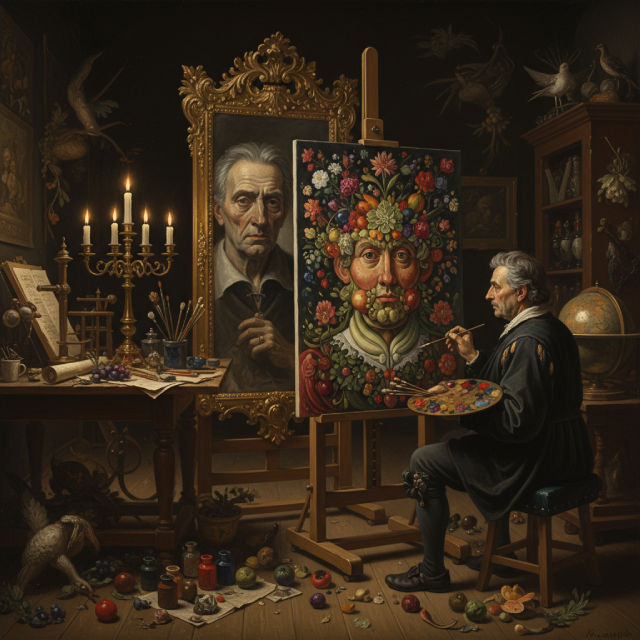
The portrait of Vertumnus is now housed at Skokloster Castle in Sweden.
Prague, winter 1600.
The daylight had long since left the tall windows of the cabinet of curiosities. Only the flickering glow of three candles remained, arranged around the Emperor's armchair.
Rudolf II sat motionless. But he was not watching the painter. He was staring at the large Venetian mirror placed just behind Giuseppe Arcimboldo. In the silvered glass, he could see his own face: drawn features, a grey beard, dark circles carved out by sleepless nights. It was the face of a man who mistrusts his own shadow. A mortal face.
Arcimboldo, for his part, was not looking at the mirror. He was looking at the Emperor, but he did not see a man. He saw a garden in winter, a fallow land, a collection of living objects.
— You are not painting, Giuseppe, Rudolf murmured in a hoarse voice. You are waiting.
— I am searching for the light, Sire. Not that of the candles. The other kind.
— There is no other light. There is only this reflection.
Rudolf gestured vaguely toward the mirror.
— That glass lies. It shows the passage of time. It shows fear. How can you paint that? How do you paint a man who no longer wishes to be seen?
Arcimboldo set his palette down on the table. The sharp knock of wood broke the silence. He rose, walked around the easel, and approached the Emperor. He did not bow. For the first time, he met his gaze as an equal.
— You are right, Sire. If I paint the man, I paint your end. I paint illness, war, old age. That is not a portrait — it is a testament.
— Then stop.
— No. I will paint you differently. I will make you disappear.
Rudolf narrowed his eyes, intrigued.
— Disappear?
— Yes. I will take your brow and turn it into a winter sky. I will take your eyes and make them holly berries. Your mouth will be an open pomegranate, your hair roots and dry leaves. You will no longer be Rudolf of Habsburg. You will be Vertumnus. You will be the Seasons.
The painter returned to his canvas. He no longer dipped his brush into flesh-coloured paints. He reached for bladder green, yellow ochre, madder red.
For hours, not a word was exchanged. Rudolf, tense at first, began to relax. As Arcimboldo erased his features on the canvas and replaced them with elements of nature, the Emperor felt a weight lift from his shoulders. He still looked at the mirror, but he no longer recognised himself in the reflection. He recognised himself in the painting.
In the mirror, an old man remained, alone. On the canvas, he was becoming a fertile empire.
Arcimboldo finally set down his brush and stepped back from the easel. — Look, Sire.
Rudolf rose. He approached the canvas. He searched for his nose, his chin, his skin. He found nothing. He saw fruits, vegetables, flowers assembled with precision. He saw perfect harmony where his own face had been marked by chaos.
He reached out to touch the painting, but stopped before making contact.
— I am not there, he said softly.
— No, Sire. You are everywhere. You have disappeared in order to reign more fully. A man may die, but the Seasons always return.
Rudolf stood before the work for a long while. In the half-darkness, his own reflection in the mirror seemed to fade, as though it had finally accepted being effaced before the immortality of the image. He was no longer the subject of the portrait. He had become its spirit.
— Keep this painting for yourself, Giuseppe, the Emperor said at last, turning away. And face the mirror to the wall.
That evening, Rudolf left the cabinet feeling lighter. He had understood Arcimboldo's secret: the only way to outlive one's own reign was to cease being a man and become an allegory. He had accepted dissolving into the painting, surrendering his body to the worries of the world, and keeping his soul in the abstraction of fruits and seasons.
Two solitudes had met: that of a painter who saw gardens in faces, and that of an emperor who wished to become invisible in order to be eternal.



