The Last Brotherhood
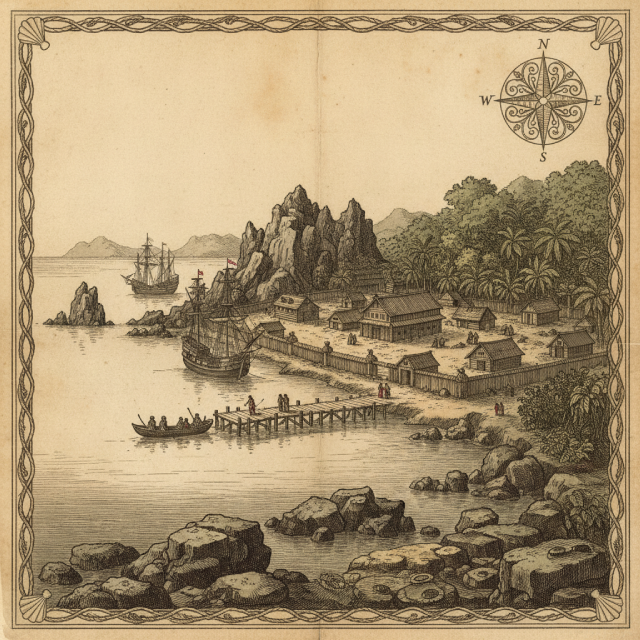
Northeastern coast of Madagascar, circa 1690
There are places that exist only because someone decided they would.
Libertalia was one of them.
It is said to have been founded by a Frenchman named Misson, captain of the Victoire, who one day laid his hand on the Bible aboard his ship and spoke words before his crew that no captain had yet dared to say: We are no one's subjects. We have no king. We have no god. We have only this sea, and one another. A defrocked priest named Caraccioli stood at his side. He had read Locke and Spinoza. He believed in the equality of men in a way the century did not yet have words to name.
Together, they set course for the Cape of Good Hope, then for Madagascar.
They were looking for a place to begin again.
The bay they chose was called Diego Suarez — a long notch in the northern coast of the island, deep and calm, sheltered from the ocean winds by a bar of red rock. They came ashore one misty morning with what they had: a few cannons, tools, seeds, and an idea. The idea was simple to state and terrifying to enact — to build a community where no man would own another man, where wealth would be shared, where races, languages, and histories would not constitute hierarchies but ordinary differences, like the colors of clothes or preferences at table.
They built houses. Then streets. Then a port.
Ships captured at sea were stripped of their holds — goods, weapons, precious metals — and everything poured into a common treasury from which each member of the community received an equal share. Not a share according to rank. Not a share according to race or country of origin. A share, simply. The word they used to name themselves was not pirate nor buccaneer nor any of those names the courts of Europe pronounced with horror. They called themselves Liberi — free men.
What makes Libertalia difficult to tell is that no one knows with certainty whether it ever truly existed.
The sole source that describes it in detail is a book published in London in 1724: A General History of the Robberies and Murders of the Most Notorious Pyrates, issued under the name of Captain Charles Johnson — a name that in all likelihood belonged to no one, or perhaps to Daniel Defoe, or perhaps to a composite figure invented for the occasion. In this book, the account of Libertalia fills two long chapters. Misson and Caraccioli are rendered with a novelistic precision that has given serious historians pause for three centuries: too fine, too coherent, too perfect in its ideals to be entirely true.
And yet.
Sailors of the period mentioned, in their logbooks, strange settlements along the Madagascan coast. Reports from the East India Company spoke of pirate establishments that resembled no ordinary lair — too organized, too stable, bearing the marks of governance, of culture, of permanence. Malagasy people from the region preserved oral memories of mixed communities settled on their shores, built at the junction of worlds. Coins, fragments of architecture, bones of mingled origins have sometimes surfaced from the earth of Diego Suarez.
Nothing sufficient to prove. Nothing sufficient to disprove.
Libertalia lives in that in-between, which may be its true country.
If it existed — and something of it existed, in one form or another, even if not exactly as described — then its duration was brief. Ten years, perhaps fifteen. Long enough for children to be born there who knew no other way of being in the world. Long enough for its rumor to cross oceans and disturb the nights of merchants and kings.
The end came, as it always does, from outside and inside at once.
The neighboring Malagasy populations, weary of the raids that supplied the colony, attacked one morning with forces the small community could not absorb. Misson, it is said, took to sea with what remained of the treasury and vanished in a storm. Caraccioli was killed in the assault. The survivors scattered across the island, along the African coasts, through the ports of the Indian Ocean. They carried with them a memory that resembled nothing else: that of a place where the rules of the world had, for a few years, been different.
What remains — whether one believes it as fact or as myth — is the question Libertalia posed.
The close of the seventeenth century was a century of slave trades, of empires, of hierarchies codified into law and blessed by churches. Wealth flowed from south to north, from low to high, from chained bodies into the hands of shareholders. Misson and Caraccioli, whether they existed or not, embodied a thought that had not yet found a respectable name: that the order of the world was not natural. That it had been constructed. And that what had been constructed could be unmade and rebuilt differently.
They did not succeed. Perhaps they could not have succeeded, stranded on a coast of Madagascar with a few hundred men and ideals too broad for so small a territory. Perhaps the violence that sustained them — the ships seized, the crews threatened — carried within it the contradiction that condemned them. One cannot build a brotherhood with impunity on foundations of plunder.
But they posed the question. And the question survived.
When the philosophers of the Enlightenment, some decades later, began to write about the social contract, the state of nature, the inalienable rights of the individual, they did not cite Libertalia. They could not cite it — it may have been nothing but a legend. But something of its logic was already moving through the air, like seeds carried by winds from an island one will never see again.
There was a Republic of pirates on a bay in Madagascar.
It lasted the length of a child's life.
It dreamed of the equality of men at a time when that idea was still a punishable offense.
And perhaps it never existed for any other reason than this: so that we might ask ourselves what it would have taken, for it to endure.



