The Imprint
For the headmaster, she is a biological time bomb. For her philosophy professor, she is living proof that the soul can transcend the flesh. The Imprint is a reflection on redemption. Can we choose to be human when everything within us compels us not to be?
I. The Cold Room
The High Peaks Institute stood like a block of granite hewn rough, isolated above the valley by a mountain road that snow rendered impassable for six months of the year. It was a place of silence, stone, and fog, where they sent difficult children, misunderstood geniuses, and cases that normal society no longer knew how to manage.
Elara had lived there for ten years. She was seventeen, with skin of a milky pallor that never tanned, and dark eyes, almost black, that rarely blinked.
She was not sick. At least, not in the conventional sense. Twenty years earlier, her mother, a worker in a failing chemical plant, had been exposed to a cloud of neurotoxins during an industrial accident. She had survived. Later Elara came. She too had survived. But doctors had noted anomalies from birth: a body temperature lower than average, an absence of startle response, and a capacity to remain motionless for hours, observing the world with a predator's patience.
In the common parlance of the Institute, they did not speak of toxins. They spoke of "the Imprint."
On this Tuesday afternoon, rain beat against the office windows. Mr. Vernier, a dry man whose career had been built on discipline and safety, tapped a file with a ballpoint pen. Opposite him, Thomas, the new philosophy teacher, waited.
— She pushed Julien down the stairs, said Vernier without looking up.
— She caught him by the collar before he hit the third step, Thomas corrected gently.
— Whatever the result. The intent was there. You didn't see her, Thomas. She wasn't even breathing. She watched him fall like one watches a stone roll.
Thomas sighed. He had seen Elara's look. It was what troubled people the most. It wasn't malice. It was a total absence of human warmth. An absolute neutrality.
— She did not choose her biology, Mr. Vernier. Her mother was poisoned. Elara bears the physiological scars of a crime she did not commit. Punishing her for her reflexes is like punishing an epileptic for a seizure.
— An epileptic does not strangle her classmates with a frightening calm, Vernier retorted, closing the file. Tomorrow, there is the excursion to Devil's Pass. It is dangerous terrain. I do not want her there. I will sign her permanent expulsion upon her return. If she returns.
Thomas stood up, feeling a cold anger rise within him.
— If you expel her based on what she might do, you validate the theory you claim to fight. You are saying she was born bad.
— I am saying she is dangerous. That is different.
Outside, in the dormitory, Elara sat on her bed, legs crossed. She was not reading. She was listening to the rhythm of the rain. She felt the vibrations of footsteps in the hallway. She knew her fate was being decided behind the director's door. She felt no fear. Fear was a chemical reaction, an adrenaline discharge that seemed to bypass her. She felt rather a sort of heaviness, as if the air around her were denser.
She raised her hand and observed her fingers. Long, thin, cold. They had told her she was a monster. She did not feel monstrous. She felt... adapted. But adaptation, in a world of warm, impulsive beings, passed for cruelty.
II. Devil's Pass
The next day, the sky had cleared, giving way to a cold sun that made the snow sparkle. The group of students, supervised by Thomas and two monitors, progressed along the ridge. Elara walked at the rear of the column, alone. No one wanted to walk beside her.
Julien, the boy she had caught the day before, walked ahead. He was tall, loud, typically human in his jerky gestures. He turned around several times to stare at her. The rumor had spread: She is going to be expelled. She is dangerous.
— Why are you following us? Julien shouted as the group paused near a rocky overhang. The void stretched behind them, a three-hundred-meter drop into the valley.
— I am part of the group, Elara replied. Her voice was monotone, without vibration.
— You are part of nothing. You are a laboratory error.
Thomas intervened, stepping between them.
— Julien, enough. Continue the hike.
— Leave him, said Elara.
She took a step forward. The movement was fluid, without friction. Julien recoiled on instinct, as if facing a rearing snake. He tripped on a loose stone. His heel slipped on the icy snow.
Time seemed to dilate. Julien tipped backward. His arms beat the air. He was a meter from the edge. The monitors screamed. Thomas made a move, but he was too far.
Elara was close. Very close. Her body reacted before her consciousness. This was the Imprint. Her muscles contracted with terrifying efficiency. She did not need to think. Her hand relaxed, ready to seize. But it was not just a reflex. In that fraction of a second, an impulse traversed her mind. An ancient, deep impulse, coming from the toxin, coming from the coldness of her blood. An inner voice that said: Let him fall. He is the threat. He is the noise. Eliminate the noise.
This was biology dictating the most efficient solution: eliminate the obstacle. Her arm was extended. She could push him slightly, accelerate the fall. No one would see. A mountain accident. Snow erases traces. She would be rid of him. She would be safe. Vernier would be right, but she would be free.
Her hand brushed Julien's jacket. She felt the warmth of the fabric. The warmth of the life panicking beneath. And in that absolute silence of her own heart, Elara did something her biology did not predict.
She did not push. She gripped.
The hold was violent. Her shoulder cracked under the weight of the boy. She did not pull him toward her gently; she anchored him. She became a fixed point, a human piton planted in the rock. Her fingers sank into the wool of the jacket, her white nails against the dark fabric.
Julien screamed, struggling, worsening the danger.
— Hold still! Elara ordered.
It was not a cry. It was a cold, absolute command. Julien froze, terrified by the tone more than by the situation. Thomas arrived finally, grabbing the boy's other arm. Together, they hauled him onto the platform.
Julien collapsed on the snow, crying, trembling with his whole body. He looked at Elara. She was standing, motionless. She was not panting. Her pulse, if one could have taken it, would have been slow. She simply shook her hand, as if to remove an invisible dust.
III. The Redemption of Shadows
The return was made in a leaden silence. In the director's office, one hour later, Vernier looked at Elara. Thomas was there, standing near the window.
— You could have let him fall, said Vernier. Everyone knows it. Julien knows it. I do too.
— Yes, Elara replied.
— Why did you not do it? Elara raised her eyes to him. For the first time, she blinked. A slow, human movement.
— Because I chose not to.
Vernier opened his mouth, then closed it. He looked for a flaw in this statement. He wanted to see manipulation, lies. But he saw nothing. Just a brute truth.
— Your file indicates that your reflexes are... altered. That your empathy is compromised.
— My body reacts fast, Elara cut in. But it is not my master.
Thomas stepped forward.
— Determinism gives us cards, Mr. Vernier. It does not force us to play the hand. Elara had the card of violence in her hands. She chose not to lay it down.
— That does not change what she is, Vernier murmured, more to himself than to them.
— No, Elara admitted. I am still the one who felt the urge to let him fall. I am still the one whose blood is cold. Redemption is not becoming someone else. It is owning what you are, and acting anyway.
Vernier took his pen. He opened the expulsion file. He looked at it for a long time. Then, he closed it and put it in a drawer, without signing.
— You will remain at the Institute, he said finally. But you will follow enhanced psychological supervision. With Thomas.
— I am not mad, said Elara.
— No. You are free. That is more complicated.
Elara left the office. The hallway was dark. She walked toward the dormitory. She still felt the vibration of Julien's jacket under her fingers. She felt the heaviness of her own nature, that genetic weight, that chemical imprint that pulled her downward, toward the shadow.
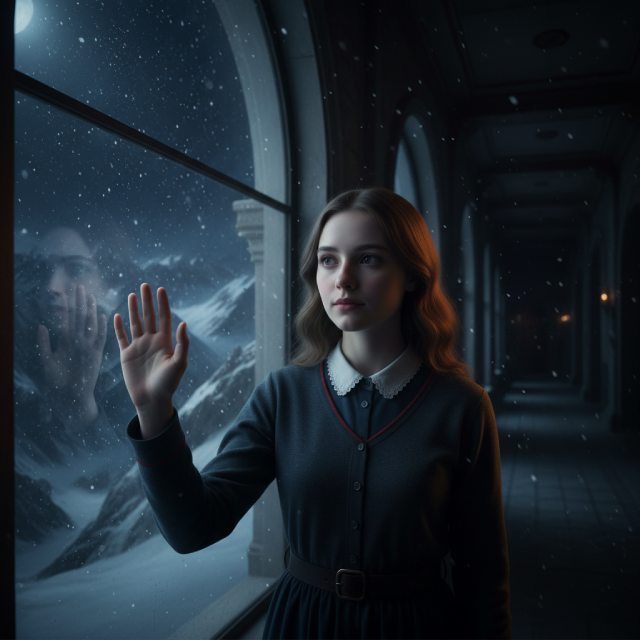
She stopped in front of a window. Outside, night was falling over the mountains. She placed her hand against the cold glass. The ice of the window responded to the coldness of her palm. She would never be like the others. She would never know spontaneous warmth, the joyful impulse, the forgetting of self. She would always be vigilant, always conscious of the beast sleeping in her cells, ready to bite if she relaxed her guard.
But as she observed her reflection in the glass, Elara smiled. A tiny smile, almost imperceptible. The snake had not possessed her. It had simply given her a choice more difficult than the others. And she had chosen.
She turned away from the window and joined the hallway, her step resonating on the parquet, unique and master of itself.



