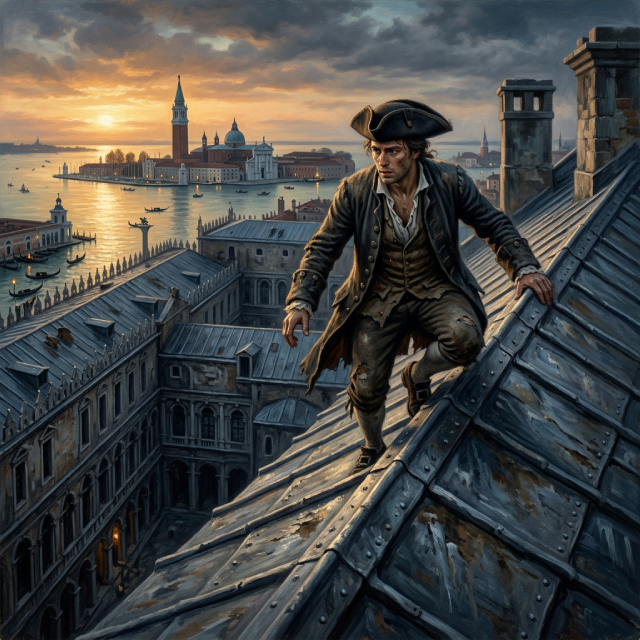
The Escape from the Piombi (Leads)
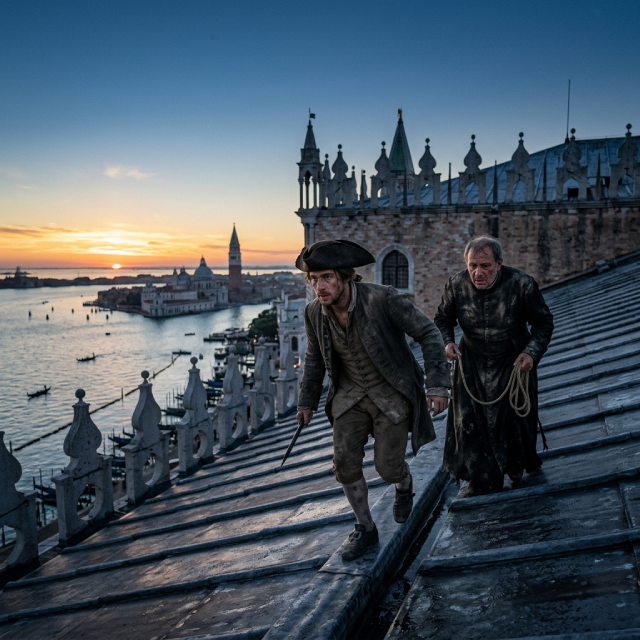
Venice, 1756
Giacomo Casanova contemplated the ceiling of his cell beneath the roofs of the Doge's Palace. Lead plates covered these roofs, hence the sinister name of this prison: the Leads. In summer, the heat was unbearable. In winter, the cold pierced you to the bone. But the worst was neither the heat nor the cold. It was the impossibility of escape.
At least, that's what all of Venice believed. No one had ever escaped from the Leads. No one.
Casanova, imprisoned for fifteen months on charges of impiety and magical practices that poorly masked the true political reasons for his incarceration, had decided to become the first.
The Impossible Plan
The idea had come to him by chance, or rather by desperation. A monk imprisoned in the neighboring cell, Father Balbi, had managed to communicate with him by sliding messages under the door. Balbi was a disreputable character, even for a monk, but he was precisely the kind of man needed for such a mad enterprise.
Casanova had obtained, through cunning, a piece of iron that he had patiently sharpened against the stone floor. Month after month, while the guards believed him resigned to his fate, he had dug into the floor of his cell, under his bed, working only at night, muffling the noise with his blankets.
But a few days before the final breakthrough, the authorities decided to transfer him to a "more comfortable" cell. Disaster. His new dungeon was intact. Months of work lost.
Casanova, on the verge of despair, then had a bold idea. He hid his iron tool in a large prayer book and sent it "by Christian charity" to Father Balbi. The message was clear: it was the monk's turn to dig now.
The Night of All Risks
On October 31, 1756, everything was ready. Balbi had pierced the ceiling of his cell and could access the attic. From there, he reached Casanova's cell through the roof and helped him pass through the hole he had created.
The two men found themselves in the dark attic of the Doge's Palace, at the very heart of Venetian power. One false step, one suspicious noise, and all would be finished.
They progressed by crawling on the beams, in almost total darkness. Casanova, elegant libertine accustomed to gilded salons, now dragged himself like a rat in dust and fear. Several times, they nearly fell through the ceiling, which would have precipitated them directly into the official apartments of the palace.
After hours of terrifying progress, they reached a window overlooking the roof. Casanova forced it open with his iron tool. They finally emerged into the open air, on the lead roofs that gave the prison its name.
Supreme Audacity
But the most dangerous part remained ahead. They were on the roof of the Doge's Palace, in the heart of Venice, without rope, without a precise plan. Dawn was approaching. In a few hours, the alarm would be sounded.
Casanova examined the surroundings. A window, a few meters below, seemed accessible. He decided to descend by clinging to the stone ornaments. Vertigo seized him halfway, but he forced himself to continue. Balbi followed him, trembling with fear.
The window, fortunately, was not locked. They found themselves in a corridor of the palace. No longer in the prison, but in the noble floors. It was both a stroke of luck and a mortal danger. If anyone discovered them now, ragged, covered in dust, no explanation would hold.
Casanova made a decision that was either genius or madness: rather than hide, he decided to act as if they had every right to be there. He dusted off his clothes as best he could, straightened his tricorn hat, and walked with determined step toward the main staircase.
A guard, drowsy, crossed their path. Casanova greeted him with natural arrogance, like a hurried patrician. The guard, intimidated or simply still half-asleep, bowed and let them pass.
Freedom Regained
They descended the grand staircase of the Doge's Palace, crossed corridors where their steps echoed, passed rooms where perhaps slept the very magistrates who had ordered Casanova's imprisonment.
The main door was closed, naturally. But a service door, used by servants, gave way after a few minutes of effort. Casanova and Balbi found themselves on the Piazzetta, facing the lagoon that shimmered in the gray light of dawn.
They were free.
Casanova hailed a gondola as if he were simply returning from a night of revelry. The gondolier, blasé, asked no questions. In Venice, one never asked questions of men who hailed gondolas at dawn.
A few hours later, after recovering money hidden with faithful friends, Casanova left Venice. He would only return many years later, under another name, for a brief stay.
The escape from the Leads caused a sensation throughout Europe. Casanova himself recounted the story many times, each time with a few more dramatic details. Some details were exaggerated, perhaps, but the essential was true: he had achieved the impossible.
Years later, while writing his Memoirs in the castle of Dux in Bohemia, Casanova would devote long pages to this escape. For him, it symbolized much more than a simple flight. It was proof that no prison, no destiny was definitive for the man who refuses to accept the unacceptable.
"I was imprisoned under the Leads," he wrote. "I escaped. That's all one needs to know."
But Venice never forgot the man who had dared to escape from the inescapable. And Casanova never forgot Venice, that city that had given him birth, that had imprisoned him, and that, despite everything, remained engraved in his heart as the only true homeland he had ever known.