The Calligrapher and the Missing Character
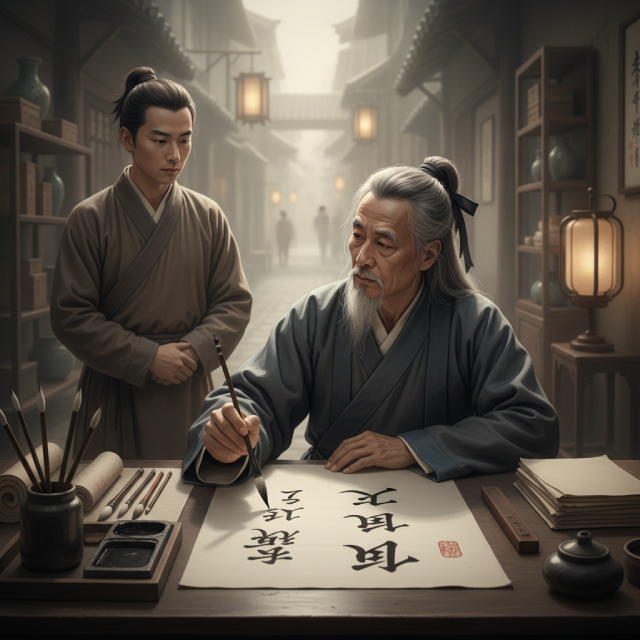
In a narrow alley, far from the grand avenues of the capital, lived Master Liang, whose hand had once been compared to the autumn wind: invisible, yet capable of bending trees.
People came from afar to contemplate his characters. Some said they breathed. Others claimed that if you looked at them long enough, you could almost hear their silence.
But that was before. Now, the door to his workshop stayed closed more often than not.
One spring morning, an imperial messenger stopped before that door. He knocked three times, with the regularity of an ancient rite.
It was the apprentice, Shen, who opened it.
— Master Liang is expected at court, said the messenger. An imperial commission. An inscription for the Pavilion of Enduring Serenity.
Shen felt his heart rise like a bird. Such a commission was a rare honor — and an immense risk. Inside, Master Liang listened without expression. He inclined his head slightly.
— I will come.
For several days, the master did not touch his brushes. He studied the paper. He ground his ink slowly, too slowly. He prepared, without ever beginning. Shen, uneasy, dared to ask:
— Master… do you already know the text?
Liang nodded.
— Yes.
— Then… why not write?
The old man was silent for a long time. Then he answered:
— Because one of the characters no longer wants to come.
Shen thought he had misheard.
— A character… no longer wants to come?
— I know how to draw it, said Liang. My hand has not forgotten. But if I draw it… it will be empty.
The text contained eight characters. Seven were written the very next day. Shen observed them, filled with wonder. Each one seemed placed like a stone set just right, neither too heavy nor too light. Together they formed a perfect balance. But one space remained white. A precise void. Intentional. Unsettling.
— It is this one, said Liang.
He did not point to the missing character. He pointed to the void.
Days passed. Shen noticed that his master slept little. Sometimes he would rise in the middle of the night, light a lamp, take up his brush… then stop before the ink ever touched the paper.
One evening, as rain fell softly on the roof tiles, Shen dared to ask the question that had been gnawing at him:
— Master… what is this character?
Liang answered without hesitation:
— Ren.
Shen frowned.
— Benevolence?
— Yes.
The young apprentice stood speechless.
— But… you have written it thousands of times.
Liang offered an almost imperceptible smile.
— Precisely.
The next day, Liang asked Shen to accompany him into the city. They crossed the market. The cries of merchants, laughter, bargaining, quarrels — everything formed a disordered music. Liang stopped before a stall where an old woman sold roots. She trembled slightly. No one seemed to want to buy. The master watched for a moment. Then he walked on.
— Master? said Shen, surprised.
Liang did not answer. Further along, a child was crying. He had been knocked down, his fruits scattered in the dust. Passersby looked, but no one stopped. Liang slowed his pace. Then continued. Shen felt uneasy.
— Why… ?
This time, Liang answered:
— Watch carefully.
In the days that followed, they repeated these walks. Each time, Shen saw what his master saw: the fatigue in the shoulders of the carriers, the hurried indifference of the wealthy, the small ordinary cruelties, almost invisible. But he also saw something else. A woman sharing her bowl. A stranger helping an old man to his feet. A merchant slipping in an extra piece of fruit without a word.
One evening, Shen stopped.
— Master… the character has not disappeared.
Liang looked at him.
— No?
— It is everywhere. But… it is fragile.
The old calligrapher nodded slowly.
— And I, he said, no longer know whether it still lives in me.
That night, Liang went out alone. Shen, worried, followed at a distance. They came to where the old woman with the roots was still standing, despite the late hour, trying to sell what remained. Liang approached. Without bargaining, he bought everything. Then he sat down beside her. They did not speak. They simply shared the silence. After a while, Liang helped her to her feet, then carried her basket all the way to her door.
Shen watched. Something in that simple gesture had the precision of a perfect brushstroke.
The next morning, at dawn, Liang rose. He ground his ink. This time, his movements were calm. No hesitation, no tension. He took up his brush. Shen held his breath. The master placed the tip on the paper. The character appeared slowly. Each stroke seemed to rise from somewhere deeper than technique — as though it passed through the hand to come from somewhere else.
When he had finished, Liang set down his brush. The void had disappeared. Yet strangely, it felt more present than ever.
Some days later, the inscription was presented at court. The officials bowed. The emperor himself studied the work at length.
— There is something here, he said at last. Something I do not often see.
Liang remained silent.
— This character, the emperor continued. It is simple. And yet it holds the whole together.
Liang inclined his head.
— Without it, everything falls apart.
Back at the workshop, Shen contemplated the work one last time before it was taken away.
— Master… did you find the character again?
Liang reflected.
Then he answered:
— No.
Shen was surprised. The old calligrapher smiled gently.
— But I understood where it hides when it disappears.
— Where?
Liang looked at his hands. Then at the street, beyond the half-open door.
— In the gestures no one writes down.
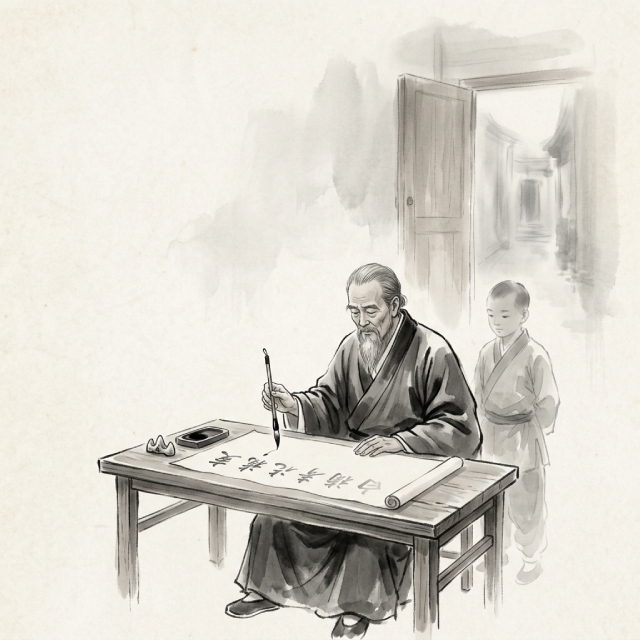
That day, Shen understood that calligraphy was not simply a matter of ink and paper — it was a way of living, and that certain characters, the simplest in appearance, demand an entire lifetime to be traced just once — correctly.



