Elagabal, the Poorly Sacrificed God
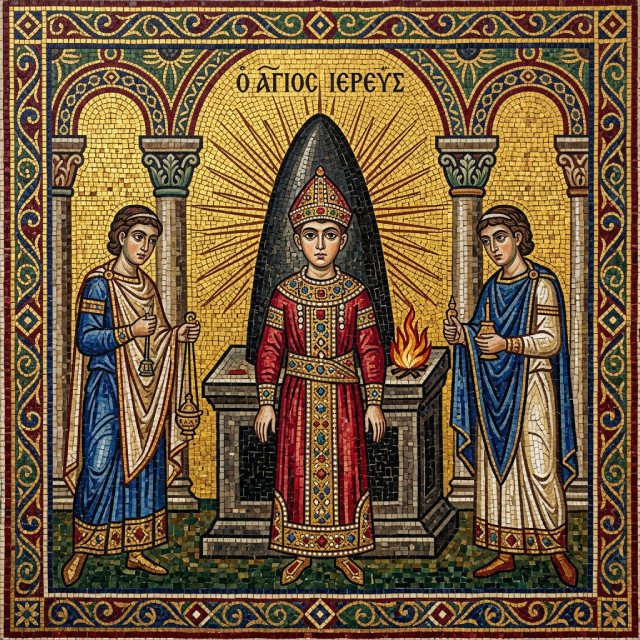
Rome, 218–222 AD
Julia Maesa was past sixty and accustomed to empires. She had watched her nephew Septimius Severus build a dynasty, she had survived Caracalla — who had more or less meant to kill her — she had crossed Macrinus's brief and failed reign like a smoke-filled room, head down, eyes open. She knew something most men in Rome did not: power is not seized, it is manufactured. And to manufacture it, you need a story.
The story she chose was this: her grandson Bassianus, fourteen years old, high priest of the sun god Elagabal in Emesa, Syria, was in fact the illegitimate son of Caracalla. Severan blood ran in his veins. The rumour was enough. The legions stationed in the East, who resented Macrinus and his obsession with military austerity, acclaimed the adolescent as emperor in May 218.
Maesa had manufactured a Caesar out of a rumour and the silhouette of a boy.
Bassianus took his god's name. He would henceforth be called Elagabalus — Antoninus Elagabalus, in official documents, so the paperwork would look serious. But it was Elagabal that would be remembered. Elagabal, or Heliogabalus, depending on the language in which one chose to despise him.
He was fourteen, and he was sincerely convinced he was a god.
This is not a figure of speech. Most Roman emperors reached divinity by posthumous decree, with the polite discretion of a man accepting an honour he knows to be slightly overstated. Elagabal did not wait for death. He had been a priest since childhood, a dancer, an officiant of an Eastern solar cult in which the body was the instrument of the divine. In Emesa, this made him a sacred figure. In Rome, it made him a spectacle.
He arrived in the city in 219, preceded by his own reputation and a black stone — a conical meteorite that the people of Emesa venerated as the earthly form of their god. He had it installed on the Palatine Hill, in a newly built temple, above Jupiter. Above Capitoline Jupiter, protector of Rome for seven centuries.
Rome had absorbed many foreign gods. It had never agreed to be told that its own were inferior.
What followed is difficult to recount without descending into caricature, because the ancient sources — Cassius Dio, the Historia Augusta — were precisely after caricature. Hated emperors become monsters in the archives; it is the privilege of survivors to write history, and the Roman senators outlived Elagabal. What can be said with relative certainty: he governed little, delegated much to his mother Julia Soaemias and his favourites, and shocked Rome in ways that had less to do with cruelty than with incongruity.
He presided over religious ceremonies in embroidered Eastern robes, face painted, following rites he had practised since childhood and that, in their Syrian context, carried no scandal. He took husbands — several, in succession, including a former slave. He arranged marriages with Vestal Virgins, overturning a symbolic order Rome regarded as stable as the foundations of the Capitol. He asked, it is said, his physicians what would be required to acquire a woman's body — a question ancient historians recorded with horror and modern historians read rather differently.
What is certain: he was sixteen, seventeen, eighteen years old. He had never left the framework that had formed him — the temple, the rite, the certainty of being an intermediary between the sun and mankind. He had been extracted from that framework and placed on the throne of Rome, and no one had thought it worth explaining the rules of the game.
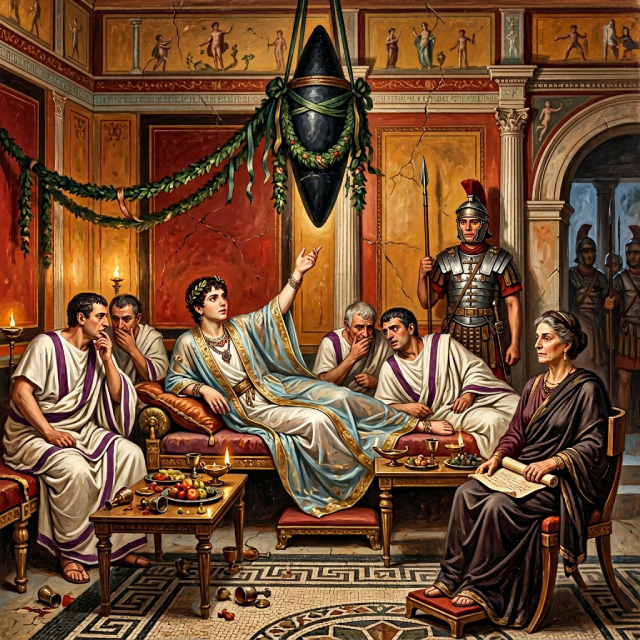
Julia Maesa, meanwhile, was watching. She had manufactured a Caesar; she could now see what she had manufactured. The legions were murmuring. The Senate was scandalized in a way that was beginning to resemble resolve. The manner in which an empire turns against a man has its own grammar, and Maesa knew it by heart.
She had another grandson. Alexander Severus, son of her second daughter Julia Mamaea — a boy of ten, discreet, educated, manageable. In 221, she persuaded Elagabal to adopt him as Caesar, as designated heir. Elagabal agreed, then had second thoughts, then attempted to have Alexander killed, then relented, then tried again.
In March 222, the Praetorians — those imperial bodyguards who had long since made a habit of settling dynastic questions in their own way — killed Elagabal in the latrines of their camp. He was eighteen years old. His mother Julia Soaemias died with him, their bodies dragged through the streets, thrown into the Tiber.
Julia Maesa proclaimed her other grandson emperor. Alexander Severus reigned. Maesa had corrected her mistake.
The black stone was sent back to Emesa.
What history remembered of Elagabal was the scandal — the catalogue of outrages, reported with a precision the ancients reserved for emperors they wished to bury twice over. What it remembered less was the mechanics of his fall: a child raised in one world, thrown into another, with no one to explain that these two worlds had different gods and that one of them would win. Julia Maesa knew this. She had simply calculated that the problem would resolve itself.
She had been right.
That may be the coldest detail in this entire story.



