The Drive of Destiny (2/3)
The Sologne night brought Thibault de Saint-Rémy no rest. The floor of the workshop, housed in an outbuilding set apart from the main body of the house, exhaled a smell of ancient sawdust and gun oil that turned his stomach. Outside, rain hammered the slate roof with the regularity of a metronome, an icy deluge that promised a memorable shoot for the morrow. Thibault wiped his brow with a nervous back of the hand. His second-hand watch, whose strap he adjusted every ten minutes, showed two in the morning. He was alone, surrounded by the shadows of the gun racks where the La Chesnaye family's rifles rested — those instruments of death that Henri-Pierre cherished more than his own nephews.
The slender, anxious son-in-law approached the workbench. Under the harsh light of a bare bulb, his father-in-law's shotgun, a side-by-side of artisanal manufacture whose walnut stock gleamed with a dark lustre, seemed to await him. Thibault did not consider himself a common assassin, but an engineer of fatality. Since poison had been betrayed by a whim of the wind, mechanics — more reliable, more predictable — would have to take over. His plan was precise. The matter was not to load the weapon, but to transform it into a metal trap ready to turn against its owner.
He seized a small precision file he had purchased in secret at an ironmonger's in Blois. His fingers, fine and accustomed to handling probate files, gripped the tool with a new firmness. He began to file the trigger of the right firing pin. The scrape of metal against metal was the only sound to rival the storm outside. Thibault worked with a jeweller's meticulousness. His objective was twofold: either to weaken the mechanism so that the trigger would jam at the critical moment, provoking a fatal helplessness before a beast at bay, or, more radically, to partially obstruct the barrel so that the pressure of the gases would cause the breech to explode in the face of whoever dared press the trigger.
It is absolutely intolerable that fate should oblige me to such extremities, he thought, blowing on the invisible filings. But after the humiliation in the sitting room, after that contempt so openly displayed by Béatrice, I have no choice. Fortune is not given — it is wrested from the metal.
He took infinite care to leave no trace of his passage. Every grain of metal dust was collected in a cloth he would burn later. He added a generous dose of petroleum jelly to the mechanism, thinking, in an excess of zeal he judged brilliant, that this surplus of lubricant would conceal the file's scratches while making the handling suspect. He reassembled the weapon with a calculated slowness, checking that nothing appeared abnormal to the naked eye. To an outside observer, the rifle was simply ready for the annual shoot. For Thibault, it was a time bomb whose countdown he held.
The following morning, the atmosphere at the château was as heavy as the lead-coloured clouds stagnating above the estate woodland. Breakfast was taken in a silence broken only by the chinking of spoons against porcelain. Henri-Pierre, dressed in his hunting jacket worn at the elbows, was devouring slices of wild boar pâté with barbaric relish. Béatrice, impeccable in her tweed suit, observed Thibault over her gold-rimmed spectacles. Her gaze was a razor blade that seemed to dissect her son-in-law's thoughts.
"You look like papier-mâché, Thibault," she remarked in a drawling voice. "Does the prospect of walking in mud terrify you to that degree? Or is it the memory of your performance the previous evening with the cognac that still haunts you?"
"I assure you, dear mother-in-law, that I am impatient to see Henri-Pierre at work," replied Thibault, adjusting his tie with feverish automatism. "The hunt is a school of patience, and I have learnt a great deal of late."
Henri-Pierre grunted with satisfaction. "Patience is all very well. But a finger on the trigger is better. A man who doesn't know how to shoot is a man who doesn't know how to choose his destiny. Come along. The beaters are already in position."
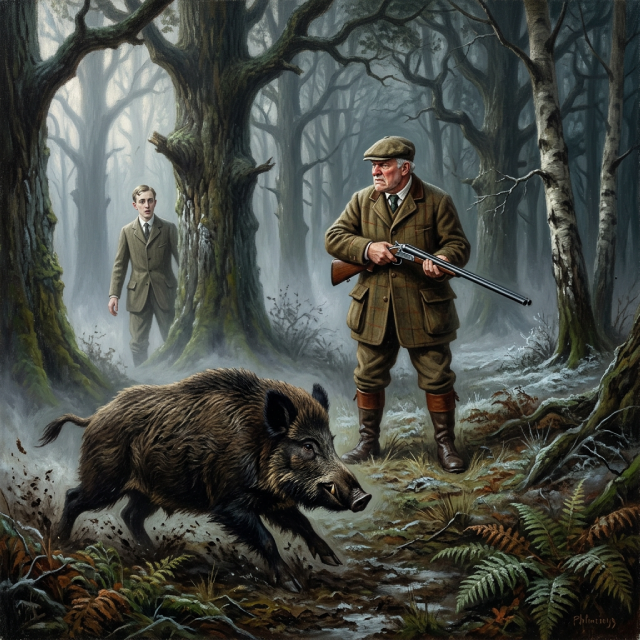
The drive began beneath a driving rain that turned the forest paths into rivers of black mud. Thibault had been posted some fifty metres from his father-in-law, on a strategic shooting line. From his position, he could observe Henri-Pierre's massive silhouette, motionless as an old oak, his sabotaged rifle resting against his shoulder. Thibault's heart beat wildly, a dull drumming in his chest that almost drowned out the distant cries of the dogs and the beaters' whistles.
The wait was interminable. Every crack of a branch, every rising partridge made the young man start. He was already imagining the explosion, the cry, the ensuing chaos. He had already rehearsed his expression of horrified grief, his calls for help, his desperate run toward the body to feign assistance. Everything was ready in his mind, a perfect staging in which he would be the bereaved son-in-law inheriting by force of circumstance.
Suddenly, a crash of breaking branches tore through the silence of the high timber. A massive wild boar, a black and furious beast weighing a good hundred kilograms, burst from the thicket, charging straight toward Henri-Pierre's line. The animal was a mass of muscle and dark bristle, ploughing the earth beneath its hooves. The old hunter did not flinch. With an economy of movement that betrayed decades of practice, he shouldered his weapon, closed one eye, and aimed at the beast's shoulder crease.
Thibault held his breath. Now. Die, you old miser. Die.
Henri-Pierre pressed the trigger. A metallic click, derisory and dry, sounded. Nothing else. No explosion. No detonation. The rifle had fallen silent, as if struck dumb by a higher will. Henri-Pierre swore, frantically worked the action, but the mechanism seemed to be swimming in an invisible treacle. The surplus of oil, combined with the ambient humidity and the sabotage of the trigger, had simply jammed the weapon. The firing pin had not even grazed the cartridge primer.
The boar, scenting danger, swerved abruptly, passing within a few metres of a furious Henri-Pierre. In a gesture of pure rage, the old man flung his useless rifle into the mud. "Blast and damnation! This blasted thing fails me at the worst possible moment!"
Before Thibault could grasp what was happening, Henri-Pierre took three strides toward him. Thibault, paralysed by surprise and the failure of his plan, had no time to react. His father-in-law literally wrenched his own rifle from his hands — a perfectly maintained and loaded weapon that Thibault had been carrying for appearances.
"Give me that!" roared Henri-Pierre. "Since you're only fit to make up the numbers, let the men do the work!"
The old man turned, aimed at the boar already retreating toward the cover of the trees, and fired. The shot rang out — clean, powerful, definitive. The beast collapsed like a dead weight, cut down in full flight by a perfect bullet that had passed clean through its heart. Silence returned to the forest, disturbed only by the hissing of the rain.
Thibault stood there, hands empty, arms dangling, staring at his father-in-law, who was reloading the weapon with an insulting ease. The frustration boiling within him was such that he feared he might faint. Not only had his attempt failed, but it had turned against him in the most humiliating manner possible.
The other hunters, alerted by the shot, soon arrived on the scene. They encircled the trophy, congratulating Henri-Pierre on his legendary marksmanship. The mood swiftly shifted when one of them retrieved Henri-Pierre's rifle from the mud.
"Just look at that," sniggered a neighbouring landowner, examining the action. "Looks as though it's been dunked in a deep-fat fryer. Who sees to your weapons, Henri-Pierre?"
The old La Chesnaye turned a contemptuous gaze upon Thibault. "My son-in-law decided to play the gunsmith last night. He thought he was doing good by putting every drop of oil on the estate into it, I imagine. He's as handy with a file as with a chequebook. If I hadn't taken his rifle, that boar would still be laughing at us."
The hunters' coarse laughter broke out, ringing beneath the vault of the trees like so many slaps across Thibault's face. He was forced to retrieve his own sabotaged rifle — the weapon he had prepared for murder and that had served only to make him a laughing stock. A glacial thought passed through him then, sending a shiver that the rain alone could not explain: had he tried to fire it himself, the jammed mechanism or the weakened breech might have exploded in his face. He had very nearly become his own victim.
The return to the hunting lodge was an ordeal. Henri-Pierre was telling anyone who would listen how he had had to save the day in the face of the incompetence of "poor Thibault." Thibault, soaked to the bone, followed the group like a beaten dog. Arriving at the porch, he crossed Béatrice's path. She was not joining in the laughter, but she was watching him fixedly. She held a steaming cup of tea between her dry hands, and an enigmatic smile, almost imperceptible, stretched her thin lips.
"A day rich in lessons, is it not, my dear?" she murmured as he passed. "You have a perseverance that borders on the absurd — it's almost touching. But do take care: those who are too eager to oil the wheels of fate often find themselves slipping on them."
Thibault did not reply. He went directly to his room, locked himself in, and collapsed onto his bed without even removing his mud-caked boots. Fate was not merely hounding him; it seemed to mock him with a refined cruelty. His watch showed five o'clock. He wound it nervously, the tic returning with greater force than ever. He was ruined, despised, and now the laughing stock of the entire Sologne. But in the darkness of the room, a sombre certainty began to take root: he could not stop there. Failure was only a stage, a trial before the final triumph. Or so he tried to convince himself as Henri-Pierre's laughter still rang out in the courtyard, triumphant and eternal.



