The Price of Insurance (3/3)
Thibault de Saint-Rémy was a broken man, an automaton of flesh and despair whose inner springs had finally given way. In the oppressive silence of his room, the ticking of his second-hand watch no longer measured the time of ambition, but that of defeat. The successive failures — those accidents that never quite were — weighed upon his shoulders like a cloak of lead. The ignored poison, the rifle jammed by excess of zeal, Henri-Pierre's mocking gaze after bringing down that boar with his own rifle... All of it formed a frieze of humiliations he could no longer endure. His debts, for their part, knew no respite. The letters of formal notice were accumulating in his desk drawer, calligraphied threats reminding him of his financial and social mediocrity.
The morning after the debacle of the hunt, he descended the oak staircase with the bearing of a condemned man. He had decided to give up. Killing was not easy, and fate seemed to have erected a wall of absurdities between him and the La Chesnaye fortune. He entered the dining room expecting the habitual coldness, Béatrice's sharp barbs or Henri-Pierre's grunts. But the atmosphere had changed. Clémence, ordinarily so distant, so draped in her elegant melancholy, welcomed him with a smile of unusual softness. She wore a pearl-grey cashmere that softened the features of her nervous face.
"My dear Thibault, you look exhausted," she murmured, handing him a steaming cup of tea. "That hunt was a trial for your nerves, I understand. Papa can be so... vigorous in his manner." She placed a light hand on his arm, a contact Thibault had not felt for months. "I know the times are difficult for us. Your investments are not bearing the expected fruit, and my parents... well, they have their demands."
Thibault looked at her, taken aback. He searched for irony in her storm-grey eyes but found only an apparent solicitude. "I no longer know what to do, Clémence," he admitted, his voice reduced to a breath. "Fate is unrelenting. Every initiative I take turns against me. It is absolutely intolerable."
Clémence sat down opposite him, smoothing her skirt with a mechanical gesture. "There is a way to ease everything, my friend. My parents doubt your commitment to the family, to the continuity of this estate. They see you as a... a passenger, if I may say so. If you were willing to prove your good faith to them, to show that you think of the future, everything would change." She paused, letting her words steep like the tea in the porcelain. "We could take out a cross life insurance policy. A mutual protection, a substantial one, that would reassure Maman as to your desire to protect the patrimony in case of hardship. It would be the pledge of a renewed alliance."
The idea passed through Thibault's mind like a glimmer of hope. Taking out an expensive life insurance policy was certainly an immediate financial sacrifice, but if it allowed him to regain the confidence of the La Chesnayes, to become the ideal son-in-law once more and, perhaps, to calm his creditors through the prospect of restored solidity, it was an acceptable strategy. He saw in it a means of buying back his image, of concealing his past intentions beneath the veneer of family foresight. "That is a proposition full of wisdom, Clémence," he replied, adjusting his watch with feverish automatism. "If it can restore harmony under this roof, I am prepared to sign whatever is needed."
The day unfolded in a strange serenity. Clémence accompanied him to Henri-Pierre's study, where a representative from a prestigious insurance company was waiting. The study smelled of cold tobacco and beeswax. Henri-Pierre remained silent in his leather armchair, observing the scene with a neutrality that contrasted with his brusqueness of the previous day. Béatrice, seated near the window, knitted with the regularity of a metronome, the clicking of her needles the only sound disturbing the calm of the room.
Thibault read the documents with feigned attention. The sums were colossal, the annual premiums exorbitant, but he signed with a sort of feverish enthusiasm. He set his name at the foot of the administrative parchments, feeling for the first time in a long while that he was regaining control of his destiny. As he set down the pen, he caught Béatrice's eye. She gave him a slight nod, an acknowledgement of his gesture which he interpreted as a victory.
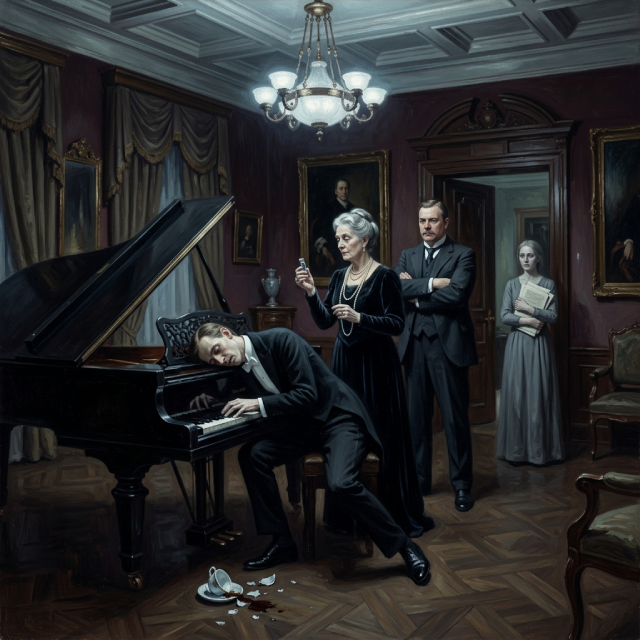
That evening, an unreal calm reigned over the château. Thibault withdrew to the music room, a vast, cold space where the grand piano stood like a monument to the glory of his wife's ancestors. He felt light, almost euphoric. The signing of the contracts seemed to have lifted a spell. He poured himself a coffee from a silver pot the maid had set upon a guéridon. The aroma was powerful, almost heady. He sat on the velvet bench, savouring the warmth of the brew as it descended his throat.
It was then that the pain struck. It was not a gradual discomfort, but a lightning discharge, an iron vice that tightened abruptly around his stomach. He dropped his cup, which shattered on the parquet in a crash of porcelain. The coffee spread like a dark bloodstain. Thibault tried to rise, but his legs gave way. His breathing became a short, laboured whistle. His heart raced, beating against his ribs with a disordered violence.
The door to the music room opened with a calculated slowness. Béatrice and Henri-Pierre entered, side by side. They were already dressed for dinner, impeccable in their provincial distinction. Béatrice approached him, her bearing as upright as ever, her sharp gaze steady behind her gold-rimmed spectacles. She showed no surprise, no anxiety. She observed his agony with the clinical curiosity of an entomologist before a pinned insect.
"You look dreadful, dear Thibault," she said in a voice as soft as it was razor-edged. "Was the coffee a touch too strong for your delicate constitution?"
Thibault tried to speak, but only a rattle escaped his lips. He gripped the edge of the piano, his fingers clawing at the lacquered wood. He fixed his gaze on Béatrice, questioning her with his eyes, seeking an explanation he was already beginning to divine in the depths of his clouding consciousness.
"Do not trouble yourself with gesticulating," Béatrice resumed, drawing from the pocket of her suit a small glass vial. Thibault recognised it immediately. It was the digitalin he had so carefully prepared weeks earlier, the poison he believed he had discarded in the tall grass after his first aborted attempt. "You were so careless, my friend. To throw such a treasure into the long grass — it's absolutely intolerable. I retrieved it the day after your little... distraction. It would have been a shame to waste a product of such quality."
Henri-Pierre allowed himself a small grunt of satisfaction. "A clean shot, Saint-Rémy. As I told you. No room for doubt. You spent your nights tinkering with rifles and tampering with brakes, yet you never understood that we knew. We observed your manoeuvres from the very first day. Every little act of sabotage, every sidelong glance... It was almost touching in its clumsiness."
Thibault slumped further, his body refusing to obey him. The pain now radiated into his arms, a cold burning that stripped him of all strength. He understood then the horrible truth. They had not survived by chance; they had survived by contempt, waiting for the opportune moment to strike in return.
"We could have reported you, of course," Béatrice continued, turning the vial between her dry fingers. "But that would have been so vulgar. And above all, it would have brought nothing to the family. We preferred to wait until you were... useful. The insurance contract you signed with such eagerness this afternoon was the last piece of the puzzle. You are costly, Thibault. Your debts are a burden to our name. It was time for you to become profitable."
A figure appeared in the doorway behind the two elders. Clémence stepped forward slowly. She held in her hand the documents signed only hours before. Her face showed no sorrow, no trace of remorse. She looked at her husband with a glacial passivity, the same elegant weariness that had always characterised her. She was no longer the submissive wife, but the silent accomplice of her own lineage.
"You know, Thibault," she murmured, her voice reduced to a perfectly articulated breath, "Maman is not eternal, but her health is discouragingly robust. Yours, on the other hand, was always so fragile. Your debts were suffocating us. This insurance is the only thing of value you have ever brought us." She folded the papers carefully, placing them in a leather wallet as one stores a collector's piece.
Thibault made one last attempt to straighten himself. His watch — that symbol of his constant anxiety — struck the piano keyboard in his desperate movement. A discordant chord, a lament of metal strings, resonated through the music room, filling the space with a broken harmony that seemed to mark the end of his own score. He fell back heavily, his head striking the ebony and ivory keys in one final sonorous crash. The light from the chandelier began to dim before his eyes, narrowing into a welcoming tunnel of darkness.
He understood, in a final flash of lucidity, that he had always been the amateur in a world of professionals. In this family, crime was not a matter of passion or murderous impulse, but a simple question of estate management. He was not an unrecognised criminal genius; he was simply a bad investment from which one divested to balance the books.
Henri-Pierre approached the motionless body and checked the pulse with a firm hand — that of a man accustomed to finishing wounded game. He gave his wife a small nod. "It's done. Clean work."
Béatrice put away the vial in her bag. She adjusted her pearls and turned to her daughter. "Clémence, my darling, go and fetch the telephone. It is time to notify the gendarmerie. Poor Thibault... overwhelmed by his financial reverses, he could not bear the pressure any longer. A tragic suicide in the music room. It is almost romantic, do you not think?"
Clémence nodded, imperturbable. "Yes, Maman. It is the most logical thing. No one will doubt that a man of such nervous disposition should have eventually cracked."
As Clémence withdrew to make the call, Henri-Pierre began to arrange several creditors' letters on the guéridon, beside the broken cup, orchestrating the tableau of despair with a meticulousness that Thibault might almost have admired. Béatrice, for her part, settled into her usual armchair and resumed her knitting as if nothing had happened. The clicking of the needles resumed its course, regular, immutable, marking the return of order to the La Chesnaye estate.
The body of Thibault de Saint-Rémy lay upon the piano, his second-hand luxury watch having stopped at the moment of the impact. Outside, the Sologne wind moaned against the windows, but inside the château, peace had at last returned. The debts would be paid, the patrimony preserved, and the lineage would continue to prosper upon the ashes of a son-in-law too ambitious for his own measure. Crime, when practised with a veneer of courtesy and accountant's rigour, had reverted to what it had always been for them: a simple tool of conservation.
Béatrice smiled at her husband, a smile of glacial tenderness. "To the table, Henri-Pierre. Dinner will go cold, and we have a long evening ahead of us with the authorities. We must be impeccable."
"Always, my dear," replied the old man, offering her his arm. "Always."
They left the room together, switching off the light behind them. The music room fell back into darkness, leaving Thibault's body alone with its failures, one last silent chord in the grand symphony of family avarice. The silence that followed was that of a settled matter, a closed file, a succession at last simplified by force of circumstance.



