The Queen Who Refused to Be One
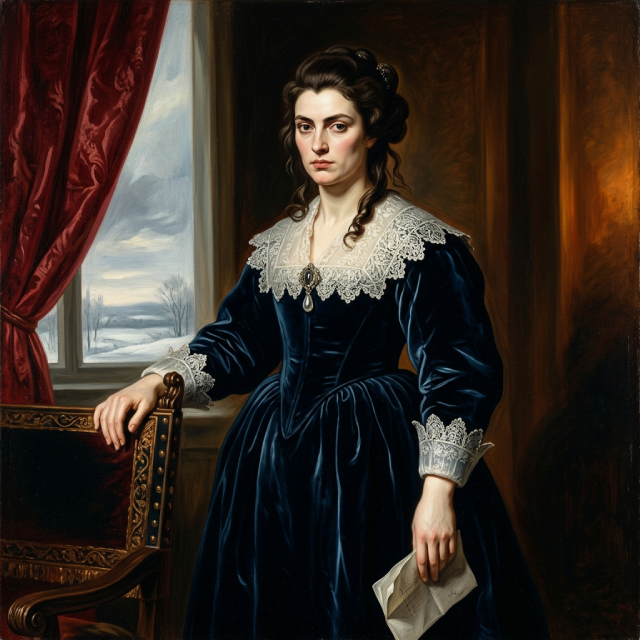
Stockholm — Rome, 1626–1689
She was born in tumult. The midwife, receiving the child, believed for a moment she held a boy — the body was covered in hair, the voice immediately powerful — and this initial confusion coloured an entire life. King Gustav II Adolf, already known as the Lion of the North, took it as a favourable omen. His daughter would be raised as a prince. He died six years later at Lützen, leaving the Swedish crown to this six-year-old child who had already learned not to cry.
Christine grew up in a cautious, cold regency, surrounded by tutors who treated her exactly as a male heir. She studied ten hours a day. Latin, Greek, mathematics, philosophy, riding, arms. She slept little and boasted of never suffering from the cold — the Swedish winter, she said, was a matter of will. At eighteen, when she took power into her own hands, the ambassadors observing her for the first time from their distant capitals did not quite know what to write. She was erudite, sharp, capricious, generous to the point of prodigality, and manifestly indifferent to the idea of marrying anyone.
Sweden expected a marriage. Europe expected a marriage. Christine was waiting for Descartes.
She had read him, annotated him, admired him from afar. In 1649, she invited him to Stockholm with the quiet insistence of someone unaccustomed to refusal. The sixty-three-year-old philosopher, used to the comfortable mornings of The Hague, found himself summoned three times a week at five in the morning to an unheated library to give lessons to a queen who, for her part, was never cold. He died of pneumonia in February 1650. Christine had it noted in the records that he had succumbed to the climate.
Her years of rule were brilliant and exhausting. She drew to Stockholm scholars, artists, and philosophers as other courts drew soldiers. She spent without restraint, emptied the treasury with a generosity that verged on contempt for money, and refused with growing constancy to broach the dynastic question. Her councillors insisted, the Riksdag insisted, suitors came and went — she heard them out with the slightly weary politeness reserved for matters already settled.
What was taking shape within her, no one saw clearly.
In 1654, at twenty-eight, Christina of Sweden abdicated.
She gave as her reasons her health, her exhaustion with power, her inability to govern as was expected of her. These reasons were not false. But there was another, which she announced only afterward: she wished to convert to Catholicism. In the most Lutheran country in Europe, this was a dynastic impossibility. She had chosen her faith over her crown — or perhaps her freedom over both.
She left Stockholm disguised as a man, crossed Europe on horseback with the speed and indifference to discomfort that were characteristic of her, and arrived in Innsbruck where her conversion was formalised. Then she descended toward Rome, where Pope Alexander VII awaited her as a prestige trophy — the Protestant queen returned to the Church. She entered the city in December 1655. Bells rang. The crowds were immense. Christine surveyed it all with satisfaction and immediately began to conduct herself as though Rome belonged to her.
It was here that Monaldeschi enters the story.
Giovanni Rinaldo Monaldeschi was her Master of the Horse, her favourite, the man in whom she had placed a trust that few people ever earned from her. In 1657, while she was staying at the Château de Fontainebleau — a guest of the King of France, negotiating for the throne of Naples — she discovered that he had betrayed her diplomatic secrets, likely intentionally though the precise details remain obscure. What is certain is that she had him summoned, presented him with the evidence of his treachery, listened to his explanations without believing them, and ordered his execution on the spot.
Her guards pursued him through the Galerie des Cerfs. He pleaded, threw himself at her feet, invoked her mercy. Christine listened, unmoved. It took twenty minutes to finish — he wore a coat of mail beneath his clothes, which the executioners had not anticipated. The King of France was outraged. All of Europe was scandalised. Could a queen — even an abdicated one — order a killing on the territory of a foreign sovereign?
Christine replied that yes, she could. She was a queen, and kings do not abdicate their nature. She dismissed the protests with the same serenity she had opposed to the Swedish cold.
The thirty Roman years that followed were of a piece: scandalous, fertile, stubbornly free. She lived at the Palazzo Riario, surrounded by a court of artists, scholars, and churchmen, a passionate patron who funded Arcangelo Corelli and was one of the founders of the Accademia dell'Arcadia. She quarrelled with the popes — several, in succession — over questions of theology, politics, and justice. When Innocent XI banned opera in Rome, she staged her own productions in her private palace. When she considered an Inquisition verdict unjust, she said so.
She never married. She never governed again. She lived precisely as she saw fit, which was scandalous for a woman of her century — and perhaps of any century.
She died in Rome in 1689, at sixty-two, after a brief illness. She was buried in Saint Peter's Basilica — an honour granted to very few laypeople. On her tomb, they carved simply her name and the date.
The crown of Sweden had long since passed to another head. She had clearly never given it another thought.
Christina of Sweden (1626–1689) reigned from 1644 to 1654 before abdicating voluntarily — at the time an act without precedent for a sovereign in full possession of her faculties. Her conversion to Catholicism, the execution of Monaldeschi at Fontainebleau in 1657, and her decades of independent life in Rome made her one of the most discussed and most misunderstood figures of her era. She remains to this day the only woman buried in Saint Peter's Basilica in the Vatican.



