Right of Reply
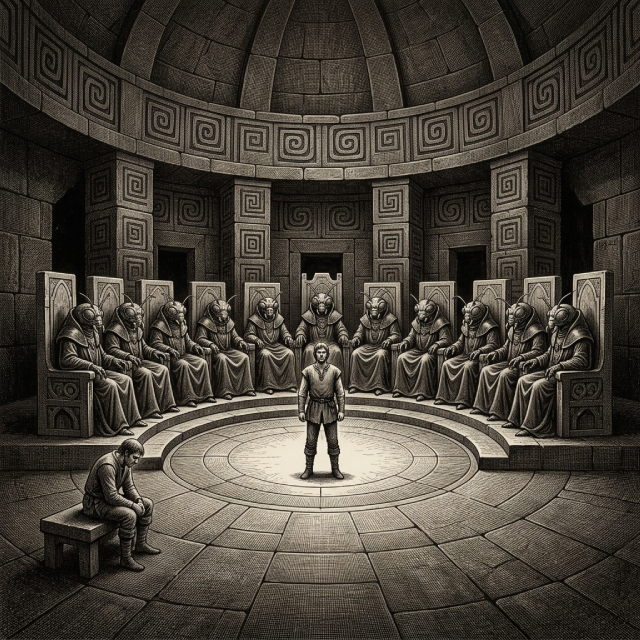
The contract had not explicitly mentioned the risk of being personally prosecuted. It was a gap Cyrus noted to report to the liaison bureau on his return — assuming there was a return.
He had arrived on Thessar IV with a standard investigation mandate, a valid Observer-advisor accreditation, and a mission that appeared straightforward: determine whether a certain Olav Brenn, a human trader established for six years in the Thess capital, had defrauded his local partners of an amount equivalent to three hundred thousand Confederation credit units. The local partners said yes. Olav Brenn said no. The liaison bureau wanted an independent assessment before authorizing an interstellar arbitration procedure.
Straightforward.
The complication had materialized on the third day, during a formal meeting with Thessar IV's legal council.
The Thess judicial system rested on an ancestral principle called the Tharr: any act of accusation, regardless of its nature, automatically opens a response window in which the accused may file counter-accusations against anyone involved in the proceedings. Including the investigators.
— He's accused me, said Cyrus to Vaelen from the legal building's waiting room, in the tone of someone stating a geological fact.
— Of what, exactly?
— Seven counts. Intrusion into a protected commercial space — I accessed his records with the local council's authorization, but apparently that authorization doesn't cover what the Thess consider his reputational space. Violation of testimonial sequence — I questioned his partners before questioning him, which is apparently the reverse of what the Tharr prescribes. And five more counts I understand less clearly.
— I've analyzed them, said Vaelen. The fourth is particularly notable: he accuses you of having altered the perceived value of the dispute by introducing an external interpretive framework. In other words, you brought your own conception of what constitutes fraud, and that conceptual framework allegedly contaminated the local process.
— That's... my job.
— On Thessar IV, introducing an external interpretive framework into a local dispute without prior declaration is a category-two procedural offense.
Cyrus looked at the waiting room ceiling. It was decorated with Thess geometric motifs, interlocking spirals that, Vaelen had explained, represented the principle that every action generates a reaction of equal amplitude, indefinitely.
— How long to respond to the accusations?
— Forty-eight hours. After that, the accusations are automatically validated. Consequences: expulsion, permanent territorial ban, referral of the file to forty-two Confederation jurisdictions for irregular exercise of investigative activity.
— Which would end our accreditation.
— Definitively.
Cyrus's first instinct would have been to find a lawyer. But Thess law did not recognize outside legal representatives in Tharr proceedings — the logic being that allowing someone else to speak on your behalf was tantamount to admitting your own word carried less weight, which weakened your position in the proceedings.
— I have to defend myself.
— Technically, said Vaelen, you have to respond yourself. Defense as you conceive it doesn't exist in the Tharr. There are only accusations and counter-accusations, until the balance tips far enough on one side for the council to designate an aggrieved party.
— So I need to accuse Brenn of something more serious than what he's accusing me of.
— Or convince the council that your actions fall under a framework that supersedes the Tharr. The interstellar treaty, for instance.
— Does it supersede?
— In theory. In practice, Thessar IV has never had to adjudicate that question. No Observer-advisor has ever been involved in a Tharr proceeding before.
— Because they all left before it got this far?
— Probably.
Cyrus stood.
— Convene a council session. I have a response to file.
The council session was held the following morning in the hall of spirals, as Cyrus had taken to calling it mentally. Twelve Thess councillors, insectoid and silent, arranged in an arc. Olav Brenn, pale with anxious pallor, seated opposite. Cyrus, alone at the center.
He began by acknowledging his procedural offenses.
— I consulted the accused's commercial records without respecting the testimonial sequence prescribed by the Tharr. I introduced an external interpretive framework. These actions were consistent with my mandate as Observer-advisor, but they were not declared in advance as local practice would have required. I acknowledge this.
An imperceptible movement among the councillors. Vaelen had told him that direct acknowledgment was rare in Tharr proceedings and generally well received.
— However, Cyrus continued, I file a counter-accusation against Olav Brenn on the following count: manipulation of the Tharr procedure for the purpose of obstructing a treaty-mandated investigation.
Silence.
— The Tharr grants every accused the right to respond. That right is legitimate. But to exercise that right not to defend a position, but to paralyze a third-party investigation by multiplying formal accusations — accusations that bear not on the substance of the inquiry, but on its procedural modalities — constitutes a misuse of the Tharr itself. And the Tharr, if I understand its spirit correctly, is designed to restore balance, not to create a new imbalance.
He paused.
— I put to the council this: the accusations brought against me do not challenge my conclusions regarding Brenn's fraud. They challenge the form of my investigation. If the substance were contestable, it would have been the substance that was attacked. An attack on form alone is an indirect admission.
The council deliberated for six hours. Vaelen spent that time reconstructing the entire Tharr jurisprudence of the past three hundred years in search of precedents, and found two, partially applicable, that Cyrus did not need to use.
The decision was rendered in the late afternoon.
Cyrus was found guilty of two minor procedural offenses. Symbolic fine, formal warning. Olav Brenn was found guilty of procedural abuse and, by implied admission, commercial fraud. The balance had tipped.
On the ship, en route to the jump corridor, Cyrus completed the mission closure form.
Resolution method: reversal of local adversarial mechanism against the obstructor.
Vaelen added a note:
Recommendation to liaison bureau: include counter-accusation risk in variable premium parameters for Thessar IV. Category: procedural friction with local cognitive bias. Risk level: considerable.
Then, after a pause:
Previous investigator survival rate on Thessar IV recalculated. The missing thirty-eight percent had likely simply departed the planet before official notification.
— That's reassuring, said Cyrus.
— I thought you'd appreciate it.



