The King Without a Title
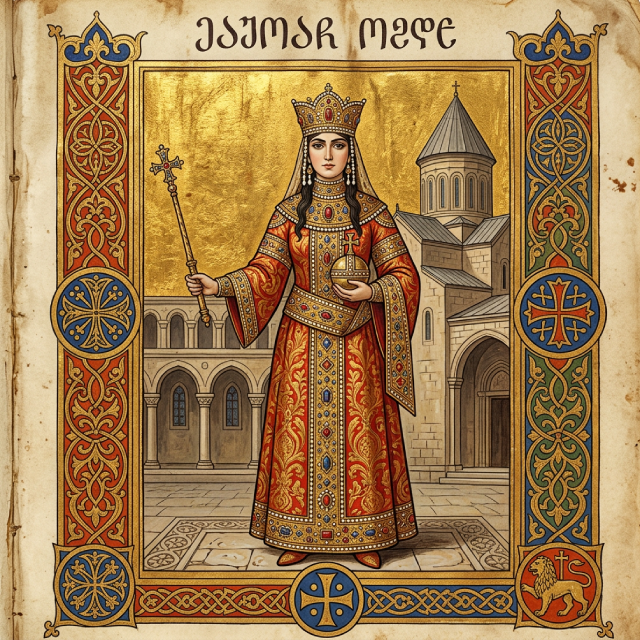
Under her rule, Georgia reached its territorial and cultural zenith, holding sultans, atabegs, and marriage suitors at bay with equal ease. The Orthodox Church canonized her. The greatest poet of her time dedicated his entire oeuvre to her. History called her Tamar the Great.
There was no word, in twelfth-century Georgian, for what she was about to become. The language had dedopali — queen, wife of the king — and mepe — king, sovereign absolute. When Tamar ascended the throne in 1184, her subjects chose the second. Not by accident. By precision.
Her father, Georges III, had no sons. He had, however, a daughter whose intelligence had drawn notice in childhood, shaped in the arts of governance by her aunt Rusudani — accomplished diplomat, formidable woman of the court — before being named co-ruler at eighteen. When Georges died in the spring of 1184, the Georgian nobility found itself confronting a designated, crowned heir who understood perfectly what she represented.
She did not make things easy for them. Or rather: she allowed them to believe she would.
The great feudal lords demanded a second coronation — a way of signaling that the first, decreed by the father, carried no legal weight without their consent. Tamar agreed. They demanded the dismissal of certain ministers of non-noble blood. She yielded again. Then a lord named Qutlu Arslan proposed what amounted to a noble parliament — an independent assembly to be installed directly across from the royal residence, a competing shadow of power. Here, she stopped. Had Qutlu arrested. Offered the rest a pardon they would have been fools to refuse. The word pardon sounded like mercy. It tasted like a warning.
There remained the question of marriage. The court, the Church, the aunt herself: everyone agreed an heir was necessary. Tamar did not object to the principle — she objected to surrendering what she had spent years constructing. They presented her with Yuri Bogolyubsky, son of a Kievan prince, a capable soldier and a man of strong character — the wrong kind of character. The marriage was contracted in 1185. For two years, Yuri drank, fought brilliantly for Georgia, and beat his wife. Tamar endured. Then Tamar documented. In 1187 she convened the council, laid out the facts — drunkenness, debauchery, brutality — and obtained a divorce. Yuri was sent to Constantinople with a generous settlement and an order not to return.
He returned twice. Each time at the head of a coalition army, determined to reclaim by force what he had failed to keep. He was defeated both times.
Free of the first marriage, Tamar chose her second husband herself: David Soslan, an Ossetian prince raised at the Georgian court, a loyal man and a fine strategist. By all accounts, this union was a success. They had two children. David commanded the armies in the field while Tamar governed from Tbilisi — not from incapacity, but from a clear division of roles. She would accompany the troops to the midpoint, bless them, send them forward, and return to administer an empire whose borders kept retreating southward and eastward.
The victories came with a regularity that bordered on the vertiginous. Shamkor in 1195, against the atabeg of Azerbaijan. Basiani in 1202, against the Seljuk sultan Rukn al-Din, who had made the error of sending Tamar a letter demanding her surrender — and proposing that if she converted to Islam, he would take her as his wife; failing that, as his concubine. Tamar's reply was impeccably courteous and perfectly clear: she placed her trust not in human armies but in the hand of God; let Him judge.
God, apparently, sided with her: Rukn al-Din's army was annihilated. In 1204, when Latin crusaders seized Constantinople and two Comnenian princes found themselves without an empire, Tamar helped them found the Empire of Trebizond on the Black Sea coast — projecting Georgian influence to the Pontic shores without shedding a drop of her own blood.
This reign was not merely conquest. It was also — perhaps above all — a flowering. Georgian chroniclers speak of a golden age, and for once the metaphor earns its weight: monasteries, roads, and institutions built; the finest artists, scholars and philosophers of the Caucasian and Persian worlds invited to court. And in this abundance, a poet named Shota Rustaveli composed The Knight in the Panther's Skin, the Georgian national epic — a work in which heroes are equal regardless of birth, in which women love and decide, and which is said to have been dedicated to Tamar. The story of an impossible love between a knight and a queen. In the poem, the queen reigns alone. The knight weeps.
Tamar died in January 1213. She was fifty-two, ruling an empire stretching from the Black Sea to the Caspian, and bearing a title the court scribes still did not know how to inflect in the feminine. They never resolved the problem. They simply called her King of Kings, Queen of Queens, Glory of the World and of the Faith, Champion of the Lord. Something for every tongue. No single word sufficient.
The Georgian Orthodox Church canonized her. She is commemorated on the first of May. Georgians speak her name the way one speaks the name of a country: with a particular way of standing straight.



