What Does Not Depend on Him
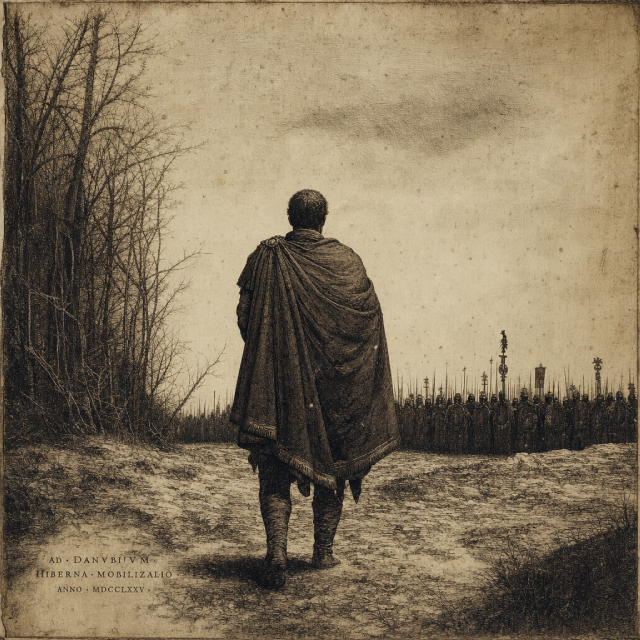
The snow has been falling since morning over the Roman camp on the Danube. Marcus Aurelius is standing outside his tent, without gloves, watching it fall.
He is fifty-three years old. He has been at war for three years against peoples whose names Rome barely knew a generation ago — the Marcomanni, the Quadi, the Sarmatians — and he will be at war for many more years yet. He knows this with the flat certainty of a man who has learned to read situations without embellishing them. The frontier will not hold itself. He will have to hold it. He is therefore here, in the snow, far from Rome, far from the libraries, far from everything that would make life worth the effort of living it, and he will remain here for as long as necessary.
He is thinking about his Meditations. Not the book — it will never be a book, it is a set of notebooks he writes for himself, in Greek, during evenings that leave him enough solitude. He is thinking about the exercise he came back to last night, the one that has been with him since his youth, since Epictetus: distinguish what depends on us from what does not depend on us.
It seems simple. It is not simple.
What depends on him: giving the order to advance or to hold. Choosing his generals. Reading the reports rather than handing them off to a secretary. Getting up in the morning when his body, which is growing old and which is growing tired, would prefer not to. Writing in the evenings. Continuing to think, even here, even in the mud, even in the cold. Governing his reactions. Not lying, not to others, not to himself. Maintaining in his mind that clear space where things can be seen as they are, without the distortions of desire or fear.
What does not depend on him: the snow. The pale. The fact that the Marcomanni is populated by people who do not wish to be governed by Rome and who have, on this point, arguments that Marcus personally finds compelling. The fact that Faustina died last autumn at Halala, of a sudden attack, on the road, and there was nothing to do but order that Halala be made a city and that the city bear her name, because that is what emperors do — they transform catastrophes into geography.
He thinks of her often — too often for a man who calls himself a Stoic, Epictetus would say, but Epictetus was a freed slave without wife or children and had not had to build forty years of shared life with someone. Marcus thinks this without bitterness. Epictetus was right about the principles. Life, however, always finds a way to overflow the principles.
The snow continues. He continues as well. He goes back into his tent, removes his gloves, sits down at the table cluttered with maps and reports. A candle sputters in the draft. He watches it for a moment — that small flame which depends on him only in that someone lit it and he has not extinguished it — then he begins to read.
In his notebooks, that evening or another evening of that same campaign, he will write something along the lines of: Do not wait for Plato's Republic to be realized, but be content to advance, however little, and hold that small progress for something. No one is supposed to read this. He writes it anyway. That is what depends on him.
The Roman army was stationed in the Danubian marches until spring 175. Marcus Aurelius returned to Rome without having finished the war. He died on campaign five years later, in 180, in the same place or nearly so, with his notebooks
.



