The Price of Grief
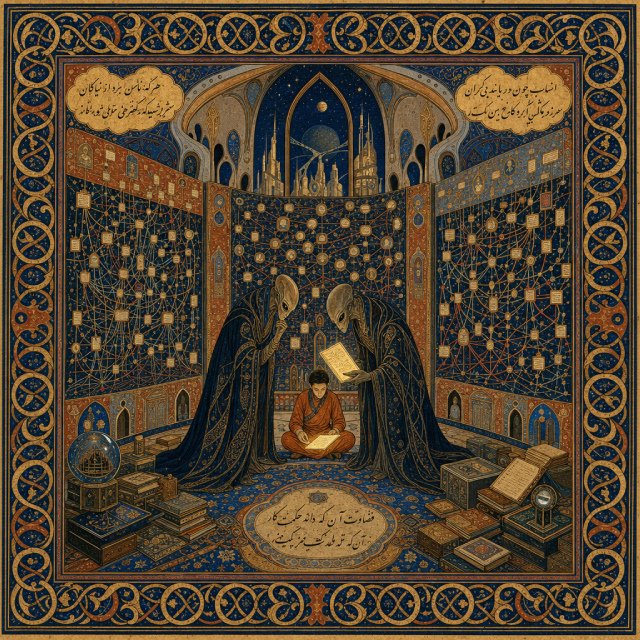
The bounty included an annexed note Cyrus read twice: the victim died of natural causes. The investigation concerns his alleged acts, not his death. It was a new configuration. He had seen many, but not this one.
Tomás Vega was seventy-one when his heart gave out in a transit hotel on Mhureth. He was retired, widowed, an amateur xeno-archaeology enthusiast. He had been traveling alone for four years, planet after planet, with the quiet obstinacy of people who have decided to spend their time what they couldn't spend otherwise. His daughter, Elena, lived in Lisbon. She hadn't seen her father in eighteen months.
She learned of his death and her legal inheritance on the same day, in the same message.
The Mhureth succession system rested on a principle Vaelen summarized plainly: responsibility does not die, it relocates. A deceased individual being unable to stand trial, their unsettled obligations passed to their direct lineage. Elena Vega therefore officially inherited three accusations filed against her father: undeclared trade in classified materials, unauthorized access to a protected excavation zone, and — the most troubling — passive complicity in the disruption of a memorial site.
— That last count, said Cyrus as their shuttle crossed the Mhureth atmosphere, what exactly does it mean?
— Memorial sites are locations where the Mhureth collectively bury their generational archives. Entering one without authorization is considered an assault on the ancestors. Passive complicity covers having been present without objecting.
— He was an amateur xeno-archaeologist. He was probably visiting ruins.
— That's the most probable thesis. The question is whether he knew what they were.
— And if Elena is declared a fugitive?
— Automatic extradition under the transit treaty. She cannot leave Confederation territory without risking arrest at any signatory port.
Cyrus looked out the porthole. Mhureth was an ancient planet, its surface covered in low, dark structures, as if the architecture were seeking to sink into the ground rather than rise from it. The light was perpetually dimmed, filtered through a dense atmosphere laden with organic particles.
— How long do we have?
— Seventy-two hours before Elena's notification is transmitted to Confederation port authorities.
The Mhureth authority handling the case was called Serath-ahn. Small, wrapped in layers of dark fabric according to local custom, she received them in an office whose walls were covered in what Cyrus first identified as tapestries and Vaelen clarified were physical genealogical registers — each thread a lineage, each knot an individual.
— You come to defend the memory of Tomás Vega, said Serath-ahn. That is a worthy endeavor. Memory deserves defense.
— We come to establish the facts, said Cyrus. If the facts exonerate him, his daughter is released from the accusations. If the facts confirm guilt, we will accept that.
Serath-ahn inclined her head. Vaelen had signaled it was the Mhureth gesture for conditional approval.
— The accusations rest on three findings. First: Tomás Vega sold, on two occasions, ceramic fragments to local collectors. These fragments originated in a classified zone. Second: his movement records place him in the protected area of Keth-Amar on three occasions. Third: during his second visit to Keth-Amar, he was accompanied by a local guide who has since disappeared.
— Disappeared how?
— He left Mhureth without notification. Which, under our law, constitutes flight.
— You believe the guide deliberately brought him into a memorial site.
— We believe Tomás Vega paid for access. The distinction between deception and complicity is what your investigation must establish.
Tomás Vega's movement records were meticulous. He kept a dense, precise digital travel journal with photographs, notes, and coordinates that Vaelen cross-referenced against official Mhureth cartography.
The result was clear.
— The three visits to Keth-Amar, said Vaelen. The first: he follows a marked tourist itinerary, stops at authorized points, photographs only open areas. His notes mention a striking atmosphere and structures of remarkable antiquity. No awareness of the site's sacred character.
— And the second?
— The second visit is with the guide. His notes indicate he believed he was visiting an active archaeological excavation zone. He mentions having paid a professional entry fee. The guide presented the visit as legal.
— So he was deceived.
— In all likelihood. But the third visit is more complex. He returned alone, two weeks later. His notes that day are brief: I wanted to understand. Nothing more.
Cyrus reread the note. I wanted to understand. A seventy-one-year-old man, alone on a foreign planet, returning to a place whose true nature he was perhaps beginning to grasp.
— The ceramic fragments he sold. Can you locate them?
— Two are with traceable local collectors. The third is in a private collection on an orbital station. I have their descriptions in the sales records.
— Do they match pieces listed as missing from the Keth-Amar archives?
Four seconds of silence.
— No. No match. The fragments sold by Vega correspond to no memorial site inventory. They do, however, correspond to surface ceramic typologies, legally collectable in non-classified peripheral zones.
— So he didn't take from the site.
— The fragments were probably in his possession before the guided visit. He had collected them on the surface, legally, and sold them without declaring their precise origin — an administrative oversight, not a crime.
Cyrus requested a supplementary hearing with Serath-ahn and presented the elements in reverse order of importance: first the fragments, whose legal provenance was established. Then the first visit, fully compliant. Then the second, where the guide's deception was documented in Vega's own notes. Finally the third.
— For the third visit, said Cyrus, I cannot tell you with certainty what Tomás Vega understood about that place. His notes say he wanted to understand. I believe he had grasped, or was beginning to grasp, that it held an importance that had been hidden from him. And that he returned not to take, but to look. Perhaps to pay his respects in his own way.
Serath-ahn was silent for a long moment.
— You cannot prove that.
— No. But you cannot prove the contrary. And under doubt, within the treaty our two systems have signed, the burden of proof falls on the accusation.
— Under our law, said Serath-ahn, the burden of proof belongs to the ancestors. They are the ones who judge.
— Your ancestors have access to his notes, said Cyrus. Read them.
Serath-ahn took Tomás Vega's notes. She read them in full — which took time, because there were four years of them. She summoned two colleagues. They deliberated.
The following morning, she transmitted a decision to the liaison bureau: charges dropped on the first two counts. Third count suspended, pending an internal assessment that would not involve Elena Vega. The daughter would not be prosecuted.
On the closure form, Cyrus wrote: resolution through submission of documentary evidence and treaty-based argumentation on burden of proof.
Vaelen added:
Personal note: Tomás Vega's travel journals constitute a document of rare ethnographic quality. They were read in their entirety by three Mhureth jurists who did not read Portuguese and required full translation. Translation took eleven hours. The seventy-two-hour deadline was exceeded by forty minutes. Port authorities had not yet been notified. Margin: none.



