The Sassanid artisans
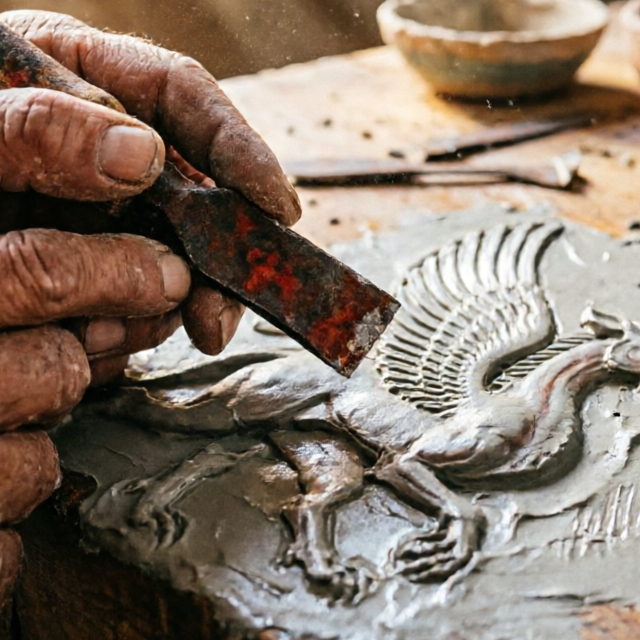
The Stucco Dust (Ctesiphon, c. 410 AD).
Hormizd never looked at the faces of the nobles who commissioned the works. He looked only at their hands, and above all, he looked at the material. In the stifling workshop of Ctesiphon, far from the clamor of the markets, the air hung still. A fine plaster dust danced in the shafts of light filtering through the terracotta latticework, forming columns of tangible sunlight.
He was carving a senmurv — that mythical creature, half-dog, half-bird, guardian of seeds — for the wall of a new fire temple. His tool, a simple iron chisel worn blunt by years of use, glided over the still-damp stucco with a soft sound, almost a whisper. He was not thinking of King Yazdegerd's glory, nor of the taxes that funded this wall. He was thinking of the way the oblique light of the winter solstice would strike the bird's wing in ten years, in twenty years, when his own hands would have become as fragile as the clay he shaped.
A young apprentice handed him a bowl of cool water. Hormizd dipped his cracked fingers into it, smoothing an infinitesimal imperfection, invisible to anyone but himself. It was a flaw in the curve of a feather, a dissonance that only the silence of the workshop could reveal to him. In correcting it, he sought not divine perfection, but a form of peace. It was there, in that silent and anonymous gesture, that the true eternity of the Empire resided — far more so than in the decrees engraved on gold.
Ink and Papyrus (Gundeshapur, c. 425 AD)

The noise of the city of Gundeshapur — the carts, the calls of the water vendors, the bells of the camels — faded behind the thick walls of the library. Mar Aba, a Nestorian Christian scribe with stooped shoulders, dipped his reed pen into the black ink. Before him lay a Greek manuscript of Hippocrates, lent by a Zoroastrian physician who had trusted him, despite the differences in their prayers.
His task was not to conquer, but to transpose: to carry the wisdom of the Greek words into the Middle Persian tongue. He paused over the word pneuma. Breath? Spirit? Vital wind? He massaged his aching wrist, feeling the joint crack softly. Through the open window, he could hear the distant rhythmic chanting of the fire priests, and, closer by, in the inner courtyard, the murmur of Jewish and Syriac students who shared the same well and the same bread.
There was no polemic in this silence, only the steady scratching of reed on parchment. Mar Aba finally chose a Pahlavi term that evoked both the warm wind of the desert and the first breath of life. In that minuscule choice, a civilization was being built, word by word, with no trumpet sounding. It was an architecture of the mind, invisible but indestructible.
The Breath of the Zagros (The Zagros Mountains, c. 440 AD)

Anahid had never seen the capital Ctesiphon. Her world was bounded by the valley, the goat herds with their hoarse-toned bells, and the small fire temple of her village, nestled like a nest in the limestone rock of the Zagros. She was the deputy keeper of this secondary fire, a responsibility she had inherited from her grandmother, and would one day pass on to her niece.
That morning was Nowruz, the new year. The air was sharp, biting, fragrant with sandalwood and freshly baked barley bread. She fed the embers with ritual care, drawing aside the grey ash to let the new cypress wood breathe and kindle. The flame rose, bright, yellow and pure, casting dancing shadows on the walls of the cave.
A transhumant shepherd had come down the day before, speaking of troop movements far to the east, near the Hephthalites, and of rumors of tribute demanded by the king. Anahid had listened, her face impassive, kneading the evening dough. These wars were like summer storms over the peaks: loud, distant, and in the end, it was always the earth that decided who survived. She laid a branch of myrtle on the fire. The wood crackled. As long as this fire burned here, in this hollow of the mountain, the world, she believed, remained in its place. The Empire was not an army; it was this warmth that kept the cold from gaining ground.
The Caravanserai of the Wind (Merv, c. 470 AD)
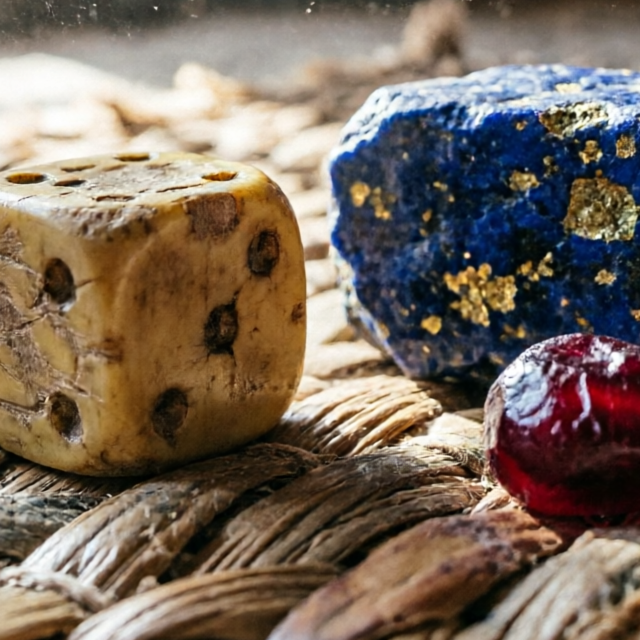
The sandstorm had sealed the caravanserai of Merv inside an ochre, muffled bubble for two days. The wind howled against the rammed-earth walls, but inside, the bustle of commerce had given way to a shared torpor, almost monastic. Rostam, a Persian merchant with dust-caked boots, sat cross-legged, turning between his fingers a dried pomegranate seed he had bartered the day before for a chip of lapis lazuli.
Across from him, a Buddhist monk from the East — from the direction of Khotan — and a Sogdian merchant with narrow eyes were sharing a wineskin of sour wine. They did not speak the same language. The Sogdian grumbled; the monk smiled. But they exchanged gestures: the elegant way of holding the wooden cup, a nod to defuse a misunderstanding, the tracing of a geometric pattern in the floor dust with one finger.
Rostam watched the monk carefully mending the hem of his ochre robe with a red thread, using a bone needle. It was not silk, silver, or spices that kept Rostam on the roads, he realized as he bit into the tart seed. It was these moments of suspension. These invisible archives of shared gestures between strangers, these tiny peaces struck around a fire, that wove the true fabric of the Empire. When the wind died down, they would each go their separate ways — but for two days, they would have inhabited the same silence.



