The Drum of the Father of Waters
He had not slept in three nights.
The village had begun to suffer at the turn of autumn, when the fishermen returned empty-handed and the livestock refused to drink from the river. A child had spoken in his sleep in a language no one recognised. An old woman had seen a shadow pass across the water — too large to belong to a fish, too silent to belong to a man. The elders exchanged heavy glances, and so they came to find Batou in his isolated yurt, at the foot of the larches.
He had known for some time what the village refused to admit: someone had broken the pact.
Among the Buryat, the world was not divided into the living and the dead, but into the visible and the invisible. The ongons — spirits of ancestors, of places, of animals — inhabited every stone, every current, every silence between two beats of the drum. They were neither benevolent nor malevolent by nature; they were demanding. They required memory, offerings, the exact word spoken at the right moment. In return, they maintained the order of the seasons, the generosity of the lake, the health of the children. But a single act of forgetting was enough. A neglected rite, a broken promise, and the balance cracked like ice in spring.
Batou had questioned the bones and the fire. He had learned that a young man in the village — impatient and mocking, as only youth can be — had taken wood from a forbidden grove: one of those circles of twisted trees that the elders marked with cloth strips and into which no one ever entered without first asking permission. He had done it at night, in secret, to fuel the fire of a celebration. He had meant no harm. He had simply not thought.
That was often how catastrophes began.
To repair the rupture, the shaman had to travel. Not along the dirt paths that linked the yurts, but along those that only the drum could open — the vertical roads of the Buryat cosmos, that invisible axis running through the three levels of the world. Below, the realm of the chthonic spirits, cold and motionless. At the centre, the surface of the human world, fragile and precious. Above, the dwellings of the celestial gods, where Tengri, the eternal Sky, observed without intervening directly in the affairs of mortals.
Batou would not go so high tonight. He needed only to reach the ezhins — the masters of places — and among them, the greatest of all: Baikal himself.
The lake was more than a body of water. It was a presence, a being that had preceded mankind and would outlast it. In the stories grandmothers passed to children during the long winter nights, Baikal was the father who had fathered rivers as one fathers sons. Angara, his favourite daughter, had fled northward to join her beloved Yenisei — and Baikal, furious and heartbroken at once, had hurled a great boulder after her, which could still be seen, solitary, at the river's mouth. That rock still carried the father's anger. But a father's anger is never without love, and that was why one could still speak to Baikal — provided one knew how.
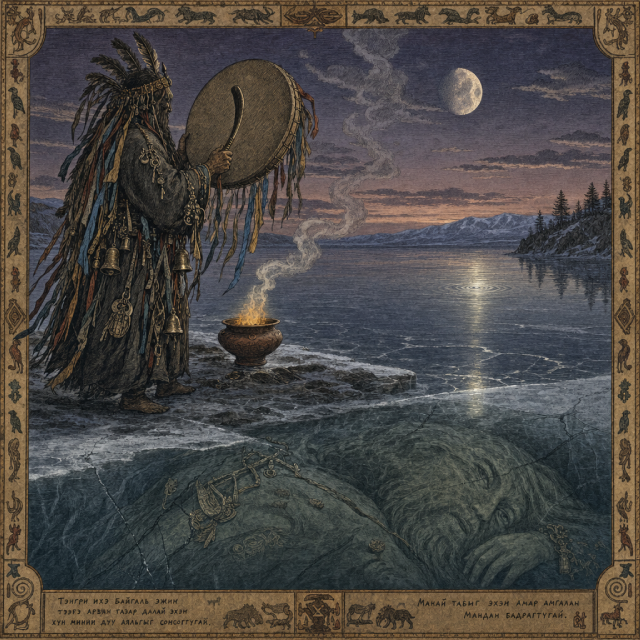
The khur now struck at a slower, deeper rhythm, as though the drum were seeking to tune itself to something beneath the surface of the ice. Batou sang in a voice that was no longer quite his own — low then high, cut through with silences worth as much as any sound. The wormwood smoke continued to rise, and within it, those who knew how to look might have made out shapes: a bird with ember-coloured feathers, a serpent of pale light, the silhouette of an old man seated cross-legged at the bottom of the waters.
The offerings lay on the ice: white milk poured toward the east, food arranged in a circle, fresh ribbons tied to a stake driven into the snow. It was not richness that mattered, but the sincerity of the gesture and the precision of the protocol. The spirits did not scorn poverty; they scorned carelessness.
Then came the shiver.
It moved across the surface of the lake from east to west — imperceptible to anyone who had not known to look for it — a faint rippling of the water where the ice had not yet formed, as though something very large and very slow had just shifted its position in the depths. Batou stopped striking. He waited, eyes closed, the snow creaking beneath his feet. And in that inhabited silence, he heard what the village needed to hear: the ancestors were not angry. They were simply tired of being forgotten.
He would return to the village before dawn. He would tell the young man to go back to the grove, to ask forgiveness aloud from the trees, and to plant three saplings in place of those he had taken. He would tell the fishermen that the lake would open its generous hands again in seven days, not before. He would tell the elders to restore the solstice rites, which had been shortened in recent years for convenience.
And he would tell no one what he had seen at the bottom of the waters during the journey — the precise depth of Baikal's gaze, that mixture of infinite patience and very ancient sorrow which resembled, more than anything, what a man feels when his children grow up and stop calling him by name.



