The Cheese
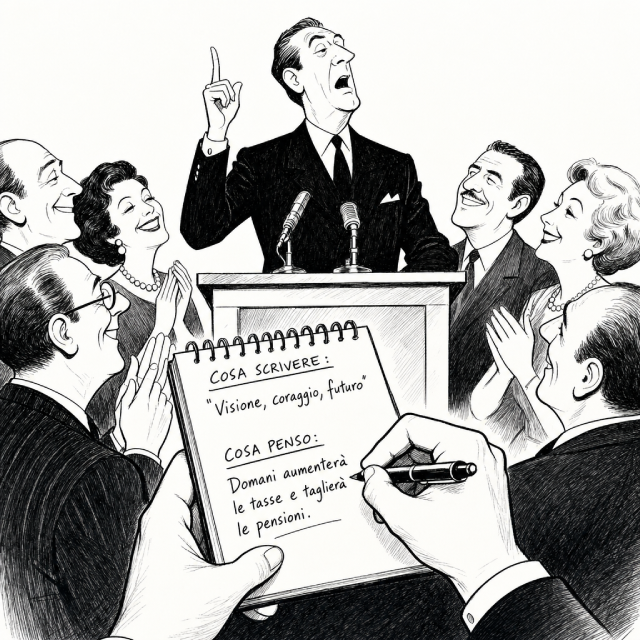
In the year of grace 1963, Giulio Andreotti was not yet Giulio Andreotti — that is to say, he was not yet the legendary creature, the man with seven lives, his back so bent and his intelligence so straight that his enemies always managed to die before him. He was still merely a forty-four-year-old politician, under-secretary to the presidency of the Council, with a reputation for cold efficiency and the kind of face caricaturists waited for with barely concealed impatience.
But this story is not about him.
It is about Franco Miele.
Franco Miele was fifty-one, built like a repentant accountant, and held the absolute conviction, forged over twenty years in the Christian Democracy party, that he was the man Italy needed without yet knowing it. This was not arrogance — or at least, it was not what he called arrogance. It was lucidity. He saw what others did not see. He understood what others did not understand. One needed only to listen to his chief of staff to be persuaded of this.
His chief of staff was named Enzo Caruso, and Enzo Caruso had understood very early — from their first meeting, in a corridor of the Palazzo Chigi in 1958 — that Franco Miele was a man who enjoyed being told he was right. This was not uncommon. What was uncommon was that Franco Miele enjoyed it with an almost touching intensity, like a child holding up a drawing and waiting for someone to stick it on the refrigerator.
Enzo had stuck a great many drawings on the refrigerator.
The spring of 1963 brought elections, and Franco Miele wanted the top of the list in his Naples constituency. This was not an unreasonable ambition — he had supporters, a network, and a local presence that his colleagues readily acknowledged, especially when he was in the room. The difficulty was that the top of the list was coveted by three other men, two of whom had stronger backing and one of whom had the advantage of being genuinely popular, which in Italian politics of that era constituted a secondary but not entirely negligible asset.
Franco Miele convened his team.
There were five of them around the table — Enzo Caruso, two political attachés, a secretary who took notes and never offered opinions, and a communications consultant from Milan who wore ties that nobody in Naples was wearing yet. The communications consultant was named Riccardo something. He was thirty-two and had the methodical enthusiasm of someone who had studied for exactly this.
— The question, said Franco Miele, settling into his chair, is how to convince the party that I am the best choice.
A brief silence followed — the kind that precedes not reflection but the calculation of what ought to be said.
— You are the best choice, said Enzo Caruso. The question is making them understand that.
Franco Miele inclined his head with the modesty of a man hearing an obvious truth confirmed.
Riccardo something, the consultant from Milan, took over with graphs. He had prepared an analysis of the constituency — the neighbourhoods, the trends, the resonant themes. He spoke of narrative, a word nobody around the table yet used but which everyone pretended to find perfectly natural. He said that Franco Miele embodied stability in a moment of uncertainty, competence in a landscape of hollow promises, the continuity that the people of Naples were calling for without always knowing how to express it.
Franco Miele listened to all of this with the concentrated attention of a man hearing himself discussed.
— And my competitors? he said.
— They have qualities, said Enzo carefully. But none of yours.
This was not untrue. It was simply incomplete in a way that proved useful.
The weeks that followed were a well-rehearsed choreography.
Each morning, Enzo Caruso brought a selection of correspondence — letters of support, testimonials from party members, favourable press. He did not mention the rest. Riccardo organised neighbourhood meetings where Franco Miele spoke and the audience, carefully prepared in advance, approved. Difficult questions were managed beforehand — not suppressed, which would have been crude, but oriented, reframed, rendered digestible before they ever reached the podium.
Franco Miele returned home each evening with the growing certainty that he was, as he had always sensed, precisely what Italy required.
He secured the top of the list.
The day the party announced it, Enzo Caruso shook his hand with a warmth that was not entirely feigned — for there was in this victory a share of his own work, and Enzo was the kind of man who could find satisfaction in a well-executed result, whatever the raw material.
— You earned this, he said.
— We earned this, said Franco Miele, with the generosity of a man who has just won.
Enzo smiled. It was technically true, and technically true was his preferred register.
Franco Miele lost the June elections by a margin wide enough to be clear but narrow enough to avoid humiliation — which was, in a sense, the worst possible outcome, because it left everyone uncertain about what exactly had gone wrong.
Enzo Caruso had a theory. He kept it to himself, as he did most of his useful theories.
Riccardo something returned to Milan with his graphs and his ties. He already had another client.
Franco Miele spent the summer identifying where the others had failed him. He did not search for long — he had people around him to assist in that inquiry, and they were very good at their jobs.



